Probably the biggest problem with using chemical pesticides is that most of them don't just kill the bad bugs that we want dead. They often kill beneficial insects as well. Then there is the issue of secondary and tertiary bad effects to other forms of life.
Let's say you want to kill this one bug that has shown up to dine on your precious lettuce, so you get out some bug spray. You kill the nasty little goblin that was munching on your romaine, but the same spray you used also killed the ground beetle who would have eaten the cutworms below the soil. This is just one example. The same insecticide that you use to kill bad insects also kills green lacewings and honey bees. I'm not saying that I wouldn't break out some Sevin dust and sprinkle a little just around the base of all my lettuce plants if I discovered that cutworms seemed to be all over the yard, because I definitely would. But I would seriously think about it.
Back in 1982, an entomologist from Cornell University, by the name of David Pimentel started a study to examine the hidden costs of using man-made pesticides, and found that indirect costs ran as high as $8 billion a year by causing the deaths of honeybees, birds, fish, and even domestic animals. His results were published in The Way We Grow, in 1993.
Right now, much of the world is beginning to panic over the loss of many bee populations. Some of the newer insecticides that were developed to have less residues and are thus thought to be safer, are actually causing more poisoning of honeybees. This actually comes from the law of unintended consequences. For example; smokers buying low tar cigarettes and then smoking twice as many to get enough nicotine in their system. Or, people driving more dangerously because they have seat belts and air bags. You may find that amazing, but it's true.
Those who farm on the commercial scale are under a lot of pressure. No one who has experienced a bad infestation of worms or beetles eating their crops can deny that the fear of such damage is real. The problem is compounded by the companies who are legitimately in business making the pesticides that we sometimes need, but who also will use that fear to sell more of their product. Most all commercial farmers just grow one or two crops. Some grow multiple crops and also livestock of various sorts, but most commercial level farmers specialize because that's how the industry has developed over the years. From this development has grown a loss of understanding of the big symbiotic picture of the relationship of all the creatures in a large biological or ecological system. If all you grow is acres and acres of corn, then all you are going to care about is which chemicals treat for the bugs and fungi that attack corn. The beekeeper and the trout farm operator downwind and downstream from you might not be your biggest concern. I'm sure there are plenty of farmers who really do care about their neighbor, but it only takes a few who are only thinking of their own farms to cause a lot of damage.
There are many other great things written on the subject of "wholistic" farming; doing the opposite of highly specialized farming. This would be too far afield for our subject in this post, but it is well worth looking into.
For now, let's look at some of the most used and widely available insecticides and how they work.
Sevin dust has been around since the sixties. Sevin is the trade name of the chemical carbaryl. It is technically a cholinesterase inhibitor, which means that it interferes with the breaking down of acetylcholine a neurotransmitter that exists in pretty much every animal in the animal kingdom. But the simple way of looking at it is that it's a nerve poison. It kills insects. All insects. Honeybees and butterflies. It kills crustaceans in the water. The reason it is preferred for food crops is because vertebrates can more rapidly detoxify and eliminate it from the body and it doesn't store up in fat cells and doesn't get secreted in milk (if cows ingest some of it). But it is still toxic in large enough amounts and is also considered a carcinogen.
Malathion is also a cholinesterase inhibitor but is much more dangerous because it not only does not break down more easily as carbaryl does, but in the human body it metabolizes into a substance called malaoxon which is substantially more toxic. Symptoms of exposure to this type of compound include cholinesterase inhibition, miosis, frontal headache, increased bronchial secretion, nausea, vomiting, sweating, abdominal cramps, diarrhea, lacrimation, increased salivation, bradycardia, cyanosis and muscular twitching of the eyelids, tongue, face and neck, possibly progressing to convulsions. Other symptoms include hyperemia of the conjunctiva, dimness of vision, rhinorrhea, bronchoconstriction, cough, fasciculation, anorexia, incontinence, eye changes, weakness, dyspnea, bronchospasm, hypotension or hypertension due to asphyxia, restlessness, anxiety, dizziness, drowsiness, tremor, ataxia, depression, confusion, neuropathy (rare), coma and death from depression of respiratory or cardiovascular systems. Exposure to this type of compound may result in giddiness, nervousness, blurred vision, discomfort (tightness) in chest, papilledema, muscular weakness, loss of reflexes, loss of sphincter control, cardiac arrhythmias, various degrees of heart block and cardiac arrest. It may also result in spasm of accommodation, aching pain in and about the eye, nystagmus, delayed distal axonopathy and parethesias and paralysis of limbs. A decrease in blood pressure may occur. Respiratory failure may also occur.
How do you like that list?
Diazinon works the same way as Sevin and malathion; cholinesterase inhibition. It's only advantage is faster breakdown, but it was banned from use on golf courses and sod farms in 1988 by the EPA because of damage to bird populations.
Pyrethrin is the organic extract from the seed cases of the chrysanthemum, also commonly called mums. Interestingly enough, the substance is also essentially a nerve poison, but it behaves completely differently from the cholinesterase inhibitors. This chemical affects the sodium ion flow out of the nerve cells, essentially causing a rapid fire or "short-circuiting" effect in the insect. While this means that it could potentially do this in humans or other mammals it would take tremendous amounts of it to do so. Pyrethrins rapidly disintegrate into inert ingredients when exposed to sunlight and air. This means that they don't last long and can't build up. But for all of its advantages, it will still kill other beneficial insects. Kenya produces about seventy percent of the world supply of pyrethrum from flowers grown by small scale farmers. Wow. Something beneficial has come out of Kenya. Not enough to offset their worst export by far, but we can be thankful for something.
Another problem with reaching first for the sprayer is the fact that insects, as well as many small life forms, have an incredible ability to adapt to life-threatening changes in their environment. The bugs that somehow survive an attack with chemical pesticides will pass on the genetic information to the next generation, creating a whole new set of problems. We then have to change chemicals to something that might now kill other beneficial species that we never intended to kill.
It cannot be over-emphasized that the destruction of bees and other pollinating insects puts the food supply in much greater danger than losing even half the crops of a given species in a given year. When entire bee colonies get wiped out, entire crops of multiple types can and do fail. There really is no comparison. Add to this the fact that now we may be finding out that Monsanto's GMO crops may be killing the bees in other ways. I can't describe how evil I think genetically modified foods are.
Ultimately, wouldn't it make more sense to encourage a balance of good, or predatory insects and animals to avoid using chemicals altogether? If we do have to resort to man-made chemicals, are we using the absolute minimum that we can get away with? Is this a situation where it would make sense to just "spot" treat the affected area? We have to remember that what we do on our own property often doesn't just effect us. The consequences can ripple out from us. Will it be like a pebble in a pond or tsunami?
My lovely wife, Twyla, writes for Enota Mountain Retreat, and you can go check out that blog. Most of this post will be edited for publishing over there.
Showing posts with label vegetables. Show all posts
Showing posts with label vegetables. Show all posts
Wednesday, May 4, 2011


Monday, May 2, 2011
Pest Control
Maybe you can relate, or maybe you can't, but there is no joy like walking out to your garden, picking some big green leaves of Romaine or Butter crunch, or some of the lower leaves of the head lettuce and knowing that they only need a little bit of rinsing to get some soil off the bottom of the stems and then you can munch away on them. No need to worry if I'm ingesting some sort of dangerous chemical into my body. Such is the way of organic gardening.
Please don't get me wrong. Don't lump me in with the crazies. I have absolutely no tolerance for the Earthfirst, or PETA people, unless PETA stands for People Eating Tasty Animals. I also think that the Enviro-Whackos who helped get DDT banned are responsible for mass murder in the millions. Sometimes chemicals are necessary. Indiscriminate use of chemicals is stupid and wrong. Wisdom involves knowing what, when, and how to use things properly.
I didn't spray insecticides last year and so far haven't needed to this year. Did I have problems? Of course. We also raise chickens. Some of my veggie seedlings weren't caged or protected well enough and they ate a couple of my cabbage plants, severely damaged one of my broccoli plants and totally destroyed my bed of mustard greens. The chickens aren't free-ranging right now. Not unless some huge windfall of money allows me to put adequate fencing around all my veggies. We don't have enough space to grow enough veggies for the chickens to eat what they want and leave us the rest.
 Not long ago, a single cut worm (that's all I could find) destroyed five out of six of my Swiss Chard plants, until I sifted through the soil and found him. Cut worms really make me angry because they don't eat the whole plant. They just cruise along in the half inch of soil, just below the surface and when they get to a juicy vegetable plant, they eat just the part that's convenient and the next day you come out to find the rest of the plant that was standing four to twelve inches in beauty now lying dead.
Now maybe some of you are thinking that it would have been smart to use plastic cups or half a tin can or toilet paper roll centers as ring barriers around each little plant. You'd be right, but I hate having to do any more work than necessary, and if I didn't have cutworms last year, I wasn't expecting them this year. I have only found two worms and there isn't any more evidence of them now. We only have a few plants that are in the ground in well amended soil. All the stuff in straw bales is not in danger of cutworms. Another big plus for using this technique.
The plants could still be in danger from all sorts of other pests, but I've learned a wonderful thing. Except for Biblical scale, wiping-everything-out plagues, most infestations are minor and can be dealt with without panicking. Most of my insect problems are being dealt with even while I am unaware of it, and it's mostly because I haven't used any chemical pesticides. It's very hard to engineer a chemical that kills only certain insects and leaves others alone, and the ones that make such a claim can end up having other effects years or months later that could be even worse. Maybe we are just overly blessed by God letting us live in this place; for God leading Twyla to buy this particular property. I just know that I don't want to mess it up.
Last year, I seemed to come across a praying mantis every time I turned around in the yard. Praying mantids are indiscriminate predators. By that, I mean that they will kill and eat any and all other insects, including their own species if they are hungry and the opportunity is there. If you read the stuff at the link I provided you might keep yourself from missing out on them.
Other insects, such as ladybugs, Coccinella septempunctata eat only the bad bugs, such as aphids. We must live in the Mecca of the ladybug world. When they first come out, you can see thousands of them in a square yard, but now I just see them here and there. Ladybugs have a penchant for crawling into warm homes in order to winter over and then come out in a vengeance when the weather starts to warm up a little bit. Some people are quite vexed by this development and will express their ire most loudly.
Ladybugs even eat the bad bugs when they are still in the larval stage, not looking anything like adult ladybugs.
I don't know much about them and haven't seen any yet, but green lacewing larvae are also supposed to be great predators of plant harming insects. The adult lacewing flies are harmless to plants, only eating pollen and nectar. Since they are so small they probably pollinate plants that bees are too big to get into.
I actually saw a ground beetle today when I was planting some flox on the back slope. I'm glad that they are so pretty and easy to spot, since these guys actually kill the darned cutworms that I hate so much. The one I saw was more on the cobalt blue side. It was barely big enough to sit on a nickel.
I don't see the variety of birds up here that I used to see further south and to the west of Atlanta. The bird we see the most is the ruby throated hummingbird. In case you didn't know, hummingbirds get all their protein from eating small insects, such as mosquitoes and other pests. They don't just suck nectar from flowers or the sugar water from my feeders. The other great mosquito controllers around here are the dragonflies, which can eat up to fifty times their weight in mosquitoes a day and catch them on the fly, er, in the air. But that's why you primarily see dragonflies where there are bodies of standing water, since that's what's required for mosquitoes to breed.
There is also the actual benefit of having some insects breeding and creating larva on the farm. When I'm out digging up composted soil or trying to create a new bed for something. I will find grubs from time to time and they are probably of the Japanese beetle or June bug variety. To my chickens they are candy. Same thing goes for fly larva that I find in the compost sometimes. The chickens get to free-range during the winter months and scratch such treats out of the soil on their own. What a benefit for us.
Some people may think I'm crazy for not taking a preventative stance by spraying or dusting, but I figure if I'm willing to lose just a little of my produce to keep the predators around and healthy, we will be rewarded for it down the road when there won't be any commercial chemical poisons around to do my killin' for me. I try to look over everything growing on the farm every day and keep my eye out for any signs that there is a problem. And because we believe in prayer, obedience to Torah, and the mercies of Adonai, we'll stick with this method until or unless we get hit with some kind of massive infestation. And then I only have the natural pyrethrin stuff to mix up, in order to keep the damage minimal. It is there only as a last resort. I much prefer to be able to reach down and pick a leaf of lettuce or a pea pod, or a really nice, ripe strawberry and just pop it in my mouth.
Twyla thinks that the reason I haven't seen any praying mantids this year is because of Pickles. Pickles has killed numerous tiger swallowtail butterflies and just loves to hunt. He's still a kitten and I don't think he'd pay any attention to me if I scolded him for pouncing on a mantis. Sometimes you just have to accept things the way they are. I have to look on the bright side. I seriously doubt that we will ever have a problem with mice or moles. There are always trade-offs. I could worry about how much it costs to feed the dogs, but that night a couple of weeks ago when Moxie and Beau chased a full grown bear out of the yard reminded me that they are worth more than just the companionship.
Pickles likes to play hard all day long, follow me around the garden and supervise, and then sleep around my head or on Twyla's hair all night. He is quite a lovable cat.
To see some other beneficial bugs, go to this site.
Please don't get me wrong. Don't lump me in with the crazies. I have absolutely no tolerance for the Earthfirst, or PETA people, unless PETA stands for People Eating Tasty Animals. I also think that the Enviro-Whackos who helped get DDT banned are responsible for mass murder in the millions. Sometimes chemicals are necessary. Indiscriminate use of chemicals is stupid and wrong. Wisdom involves knowing what, when, and how to use things properly.
I didn't spray insecticides last year and so far haven't needed to this year. Did I have problems? Of course. We also raise chickens. Some of my veggie seedlings weren't caged or protected well enough and they ate a couple of my cabbage plants, severely damaged one of my broccoli plants and totally destroyed my bed of mustard greens. The chickens aren't free-ranging right now. Not unless some huge windfall of money allows me to put adequate fencing around all my veggies. We don't have enough space to grow enough veggies for the chickens to eat what they want and leave us the rest.
Not long ago, a single cut worm (that's all I could find) destroyed five out of six of my Swiss Chard plants, until I sifted through the soil and found him. Cut worms really make me angry because they don't eat the whole plant. They just cruise along in the half inch of soil, just below the surface and when they get to a juicy vegetable plant, they eat just the part that's convenient and the next day you come out to find the rest of the plant that was standing four to twelve inches in beauty now lying dead.Now maybe some of you are thinking that it would have been smart to use plastic cups or half a tin can or toilet paper roll centers as ring barriers around each little plant. You'd be right, but I hate having to do any more work than necessary, and if I didn't have cutworms last year, I wasn't expecting them this year. I have only found two worms and there isn't any more evidence of them now. We only have a few plants that are in the ground in well amended soil. All the stuff in straw bales is not in danger of cutworms. Another big plus for using this technique.
The plants could still be in danger from all sorts of other pests, but I've learned a wonderful thing. Except for Biblical scale, wiping-everything-out plagues, most infestations are minor and can be dealt with without panicking. Most of my insect problems are being dealt with even while I am unaware of it, and it's mostly because I haven't used any chemical pesticides. It's very hard to engineer a chemical that kills only certain insects and leaves others alone, and the ones that make such a claim can end up having other effects years or months later that could be even worse. Maybe we are just overly blessed by God letting us live in this place; for God leading Twyla to buy this particular property. I just know that I don't want to mess it up.
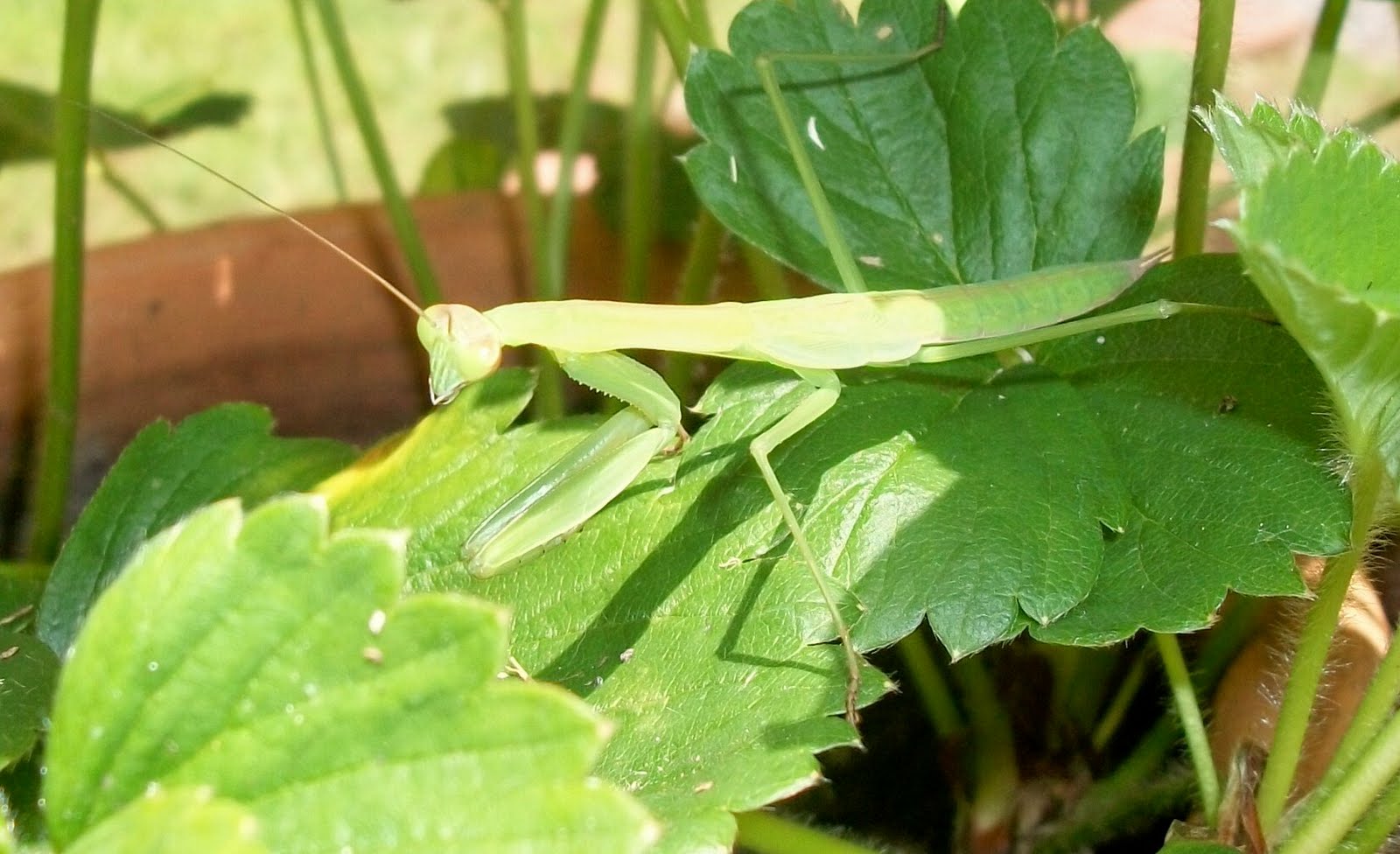 |
| A friend from last year on the strawberries |
Last year, I seemed to come across a praying mantis every time I turned around in the yard. Praying mantids are indiscriminate predators. By that, I mean that they will kill and eat any and all other insects, including their own species if they are hungry and the opportunity is there. If you read the stuff at the link I provided you might keep yourself from missing out on them.
 |
| Ladybug larvae |
Other insects, such as ladybugs, Coccinella septempunctata eat only the bad bugs, such as aphids. We must live in the Mecca of the ladybug world. When they first come out, you can see thousands of them in a square yard, but now I just see them here and there. Ladybugs have a penchant for crawling into warm homes in order to winter over and then come out in a vengeance when the weather starts to warm up a little bit. Some people are quite vexed by this development and will express their ire most loudly.
Ladybugs even eat the bad bugs when they are still in the larval stage, not looking anything like adult ladybugs.
I don't know much about them and haven't seen any yet, but green lacewing larvae are also supposed to be great predators of plant harming insects. The adult lacewing flies are harmless to plants, only eating pollen and nectar. Since they are so small they probably pollinate plants that bees are too big to get into.
 |
| Ground Beetle |
I actually saw a ground beetle today when I was planting some flox on the back slope. I'm glad that they are so pretty and easy to spot, since these guys actually kill the darned cutworms that I hate so much. The one I saw was more on the cobalt blue side. It was barely big enough to sit on a nickel.
I don't see the variety of birds up here that I used to see further south and to the west of Atlanta. The bird we see the most is the ruby throated hummingbird. In case you didn't know, hummingbirds get all their protein from eating small insects, such as mosquitoes and other pests. They don't just suck nectar from flowers or the sugar water from my feeders. The other great mosquito controllers around here are the dragonflies, which can eat up to fifty times their weight in mosquitoes a day and catch them on the fly, er, in the air. But that's why you primarily see dragonflies where there are bodies of standing water, since that's what's required for mosquitoes to breed.
There is also the actual benefit of having some insects breeding and creating larva on the farm. When I'm out digging up composted soil or trying to create a new bed for something. I will find grubs from time to time and they are probably of the Japanese beetle or June bug variety. To my chickens they are candy. Same thing goes for fly larva that I find in the compost sometimes. The chickens get to free-range during the winter months and scratch such treats out of the soil on their own. What a benefit for us.
 |
| Hey! How do I get in here? |
 |
| I don't think I can ride like this. |
 |
| Oh, come on! I wanna go! |
Pickles likes to play hard all day long, follow me around the garden and supervise, and then sleep around my head or on Twyla's hair all night. He is quite a lovable cat.
To see some other beneficial bugs, go to this site.
Tuesday, November 16, 2010
Mountain Rain
Having been a Florida boy for most of my life, rain in the mountains is something different. There are times when we are actually in the bottoms of the clouds, which is like being in a thick fog while it's raining. Something I never experienced in Florida. A hard rain in the mountains is nothing like a hard rain in Central or South Florida. I've been in rain on the road that was so hard, you couldn't see the end of your hood. Wipers on high were merely there to let you know you couldn't see any farther than that. I was once caught in a downpour on Hillsborough Avenue in Tampa that had come down so hard and so fast that the runoff into the storm sewer system was causing manhole covers in the road to dance. I'm pretty sure there are some people who find that hard to believe, but it's true. Water was ejecting straight up into the air through the hook hole and around the edges. Made me think of Noah's flood and the passage that talks about the fountains of the deep breaking open.

I'm glad we don't really get anything like that here. At least I haven't experienced it and haven't heard any of the locals say that it has happened. Yesterday it rained softly pretty much all day long. Occasionally the wind picked up a little, which had me going out to straighten or adjust the plastic sheeting over the chicks or on one of the arks.
I moved the chicks to the flat area behind the house, up from the area near the azaleas in the front most part of the yard. They are up against the beginning of the steep rise up to the next road above our house. After putting the plastic sheeting on, I piled leaves in between the hill and the cage to provide some more insulation and hold the edge of the sheeting down. They all seem quite content there. The nice thing is that we can sit at the dining room table and eat or study Torah and look up and see them all there, just beyond the back porch.
We had had five straight days of dry cool weather with mostly sun. It was quite nice, since it allowed me to be out in the yard cutting firewood wearing nothing but shorts and producing copious amounts of vitamin D. I think I'm beginning to see a connection between the vitamin D and sleeping better. I'm really glad to see that most of that stupid hysteria about tanning is beginning to wane. That bunch of pseudo science and the bunk about salt have always been a thorn to me.

Because of the rain, we didn't let the fire die out in the late morning so we could clean the stove out and start fresh. The previous three days, I wouldn't even light the fire until after 21:00. Even CassPurr noticed the chill that becomes more felt from all that moisture in the air. Several times a day he would end up laying at just the right distance from the stove.
About once an hour, we just toss in one or two small logs or pieces. You could tell if the stove was hungry just by walking through the kitchen. When I was cutting wood out in the yard the other day, I looked around our yard and just marveled at the amount of deadfall that I had available, even before I start cutting down any trees.
My winter vegetables really perked up from the soaking rain. With a steady temperature of about 52° F, you could almost see them growing. We have picked and eaten salad almost every day. Even gave a bunch away to friends who were visiting. The Swiss chard has really perked up and grown more. One of the varieties of that plant is called rhubarb, because the stem and veins of the plant are red. Actually more like ranging from fucshia to ruby. We also have some that has bright yellow stems. I guess you could say the Swiss chard tastes like spinach, except the leaves are slightly thicker and crunchier. Which makes me want to say something to all my readers who might be thinking, "Spinach? Yuck!"
I got news for you, fresh, green leafy vegetables right out of the garden don't taste anything like what you buy in the supermarket. That even goes for the fresh produce aisle. It goes double for the frozen section, and it goes quadruple for the canned goods. Fresh greens out of my garden are as pleasant to eat as Iceberg or Romaine lettuce. Yes, they have their own distinct flavors, but there is nothing bitter or odd tasting about them. It's something you have to experience to understand. Just like when I picked a pea pod right off the vine in front of a guest and had him taste it. He couldn't believe the sweet deliciousness. I explained that once it was picked, in four days that flavor would pretty much be gone, which is why you just can't get that kind of quality from a supermarket.
 The broccoli is a bit more slow growing than I expected, but it looks beautiful. The heads are about the size of baseballs now. I have a dozen more broccoli seedlings on the front porch, along with several other varieties of early spring greens. I still don't see any sign that the little cabbage like heads are going to form on the Brussel sprout plants, but I must be patient. I'm starting some Salsify once again. I don't know if it was the grasshoppers or some other insect that likes it so much, but two other attempts at growing it failed because once the sprouts got about 3" high, something would eat it. I'm sprouting this batch in the porch greenhouse.
I haven't posted to this blog as much as I wanted. Not because there isn't plenty to blog about, but because I'm extremely busy keeping up with all this stuff. One of the next projects is to build a mini outside greenhouse over an area of prepared mulch to grow some fresh greens for when the freezes get severe. I want another mini greenhouse outside somewhere to start my tomato and pepper plants.
It's starting to get light outside, so off I go. Shalom.

I'm glad we don't really get anything like that here. At least I haven't experienced it and haven't heard any of the locals say that it has happened. Yesterday it rained softly pretty much all day long. Occasionally the wind picked up a little, which had me going out to straighten or adjust the plastic sheeting over the chicks or on one of the arks.
I moved the chicks to the flat area behind the house, up from the area near the azaleas in the front most part of the yard. They are up against the beginning of the steep rise up to the next road above our house. After putting the plastic sheeting on, I piled leaves in between the hill and the cage to provide some more insulation and hold the edge of the sheeting down. They all seem quite content there. The nice thing is that we can sit at the dining room table and eat or study Torah and look up and see them all there, just beyond the back porch.
We had had five straight days of dry cool weather with mostly sun. It was quite nice, since it allowed me to be out in the yard cutting firewood wearing nothing but shorts and producing copious amounts of vitamin D. I think I'm beginning to see a connection between the vitamin D and sleeping better. I'm really glad to see that most of that stupid hysteria about tanning is beginning to wane. That bunch of pseudo science and the bunk about salt have always been a thorn to me.

Because of the rain, we didn't let the fire die out in the late morning so we could clean the stove out and start fresh. The previous three days, I wouldn't even light the fire until after 21:00. Even CassPurr noticed the chill that becomes more felt from all that moisture in the air. Several times a day he would end up laying at just the right distance from the stove.
About once an hour, we just toss in one or two small logs or pieces. You could tell if the stove was hungry just by walking through the kitchen. When I was cutting wood out in the yard the other day, I looked around our yard and just marveled at the amount of deadfall that I had available, even before I start cutting down any trees.
My winter vegetables really perked up from the soaking rain. With a steady temperature of about 52° F, you could almost see them growing. We have picked and eaten salad almost every day. Even gave a bunch away to friends who were visiting. The Swiss chard has really perked up and grown more. One of the varieties of that plant is called rhubarb, because the stem and veins of the plant are red. Actually more like ranging from fucshia to ruby. We also have some that has bright yellow stems. I guess you could say the Swiss chard tastes like spinach, except the leaves are slightly thicker and crunchier. Which makes me want to say something to all my readers who might be thinking, "Spinach? Yuck!"
 |
| L -R: Broccoli, Iceberg lettuce, Brussel sprouts |
I got news for you, fresh, green leafy vegetables right out of the garden don't taste anything like what you buy in the supermarket. That even goes for the fresh produce aisle. It goes double for the frozen section, and it goes quadruple for the canned goods. Fresh greens out of my garden are as pleasant to eat as Iceberg or Romaine lettuce. Yes, they have their own distinct flavors, but there is nothing bitter or odd tasting about them. It's something you have to experience to understand. Just like when I picked a pea pod right off the vine in front of a guest and had him taste it. He couldn't believe the sweet deliciousness. I explained that once it was picked, in four days that flavor would pretty much be gone, which is why you just can't get that kind of quality from a supermarket.

I haven't posted to this blog as much as I wanted. Not because there isn't plenty to blog about, but because I'm extremely busy keeping up with all this stuff. One of the next projects is to build a mini outside greenhouse over an area of prepared mulch to grow some fresh greens for when the freezes get severe. I want another mini greenhouse outside somewhere to start my tomato and pepper plants.
It's starting to get light outside, so off I go. Shalom.
Subscribe to:
Posts (Atom)