"Good intentions will always be pleaded for every assumption of authority ... the Constitution was made to guard against the dangers of good intentions. There are men in all ages who mean to govern well, but they mean to govern. They promise to be good masters, but they mean to be masters." - Noah Webster


"There is no worse tyranny than forcing a man to pay for what he does not want just because you think it would be good for him."
-- Robert A. Heinlein

Showing posts with label farming. Show all posts

Friday, June 24, 2011

Making Sense Now


DOUBLE RED ALERT
POSTED BY ANN BARNHARDT - JUNE 24, AD 2011 9:01 AM MST


Two HUGE intel leads in my email box this morning from way-back contacts that I've had for years, that are actually somewhat connected concepts.1. File this one under "Now It All Makes Sense". A Missouri farming and ranching contact just got off a conference call wherein he was informed that the federal government is sending out letters to all of the flooded out farmers in the Missouri River flood plain and bottoms notifying them that the Army Corps of Engineers will offer to BUY THEIR LAND.
Intentionally flood massive acreage of highly productive farmground. Destroy people's communities and homes. Catch them while they are desperate and afraid and then swoop in and buy the ground cheap. Those evil sons of bitches.
2. Speaking of evil sons of bitches, George Soros appears to be "investing" in farmground through the same puppet company that he used to get into the grain elevator and fertilizer business. The company is called Ospraie Capital Management and is buying up farmground in a joint venture with Teays River Investments as a partner. Here is that announcement:
Click Here
Okay. Here's the connection. This Ospraie outfit was a hedge fund specializing in commodities that was started and run by some cocky child who didn't know how to trade bear markets and got his butt kicked into next week in the grain market of 2008. He also lost a fortune trying to trade RARE EARTH METALS. In fact, it was so bad that he had to shut his fund down because he had promised his investors that he would give them all of their investment money back if the fund lost more than 30% in one year. Whoopsie.
But it appears that Soros swooped in and saved the day because this Ospraie is the "co-investor" with Soros that bought the remnants of ConAgra's trading operation and renamed it . . . Gavilon. In the industry, it is widely acknowledged that Ospraie IS Soros. That three-page article citation is here, copy and paste the URL into your address bar:
http://money.cnn.com/2008/11/12/news/companies/ospraie_demos.fortune/index.htm
As you probably remember, Gavilon just recently bought both DeBruce Grain out of Kansas City and the biggest grain elevator company in the Pacific Northwest, thus making Soros (who is the money behind Gavilon through both his own Soros Fund Management AND his de facto control of Ospraie) the third-largest grain company in the U.S. with 280 million bushels of storage capacity, behind only Archer Daniels Midland (542 million bushels storage capacity) and Cargill (344 million bushels storage capacity). That citation is here:
http://www.world-grain.com/News/News%20Home/Features/2010/12/A%20powerful%20signal.aspx?p=1
Bottom line: Soros, through Ospraie, is buying up farmground. Please also note that the hotlink citation above is dated June 26, 2009. My contact says this has been going on for two years - and also remember what I told you about farmground prices inflating wildly, especially in Illinois. I have personally confirmed farmground in Illinois selling for $13,000 per acre within the last month, whereas that same kind of ground in Illinois was going for $5500 per acre the day Obama was inaugurated.

Spread the word.  

For the original post go to Barnhardt.biz


Thursday, May 26, 2011

Garden Update May 26, 2011

So our friends can see how things are progressing here:


Hard to believe that in another month, you will hardly be able to see any of the straw bales in the front because they will be covered over with squash leaves.  We eat stuff out of the garden every day.


Two terraced beds above the asparagus beds.  They contain radish, carrots, mint, and cosmos.  Twyla's gotta have her flowers.  That terracing takes hours and hours of hard work.

Remember the potato cage and other beds?

Potato bed from May 11
Potato bed May 26
Then there's the ongoing potato cage project:


There is about 8 more inches of leaves and compost added to the cage.  It's hard to keep up with.
I'm beginning to think we will not have to buy any more potatoes after this fall.

This has been a very, very brief update.  Now I need to get back on that eschatology post.

Tuesday, May 24, 2011

Long Live, O' Live, Olive

Our new olive tree

The nicest birthday gift I received this year came from my lovely wife, Twyla. I consider it ours, and not mine. Every time I walk past it, it makes me smile.  I think of how much joy it will bring me to care for it and shape it as it grows.  Olive trees are one of the ideal trees for pruning and shaping.  Olive trees, the fruit, and the oil, all have special meaning. Now, I've got this cute little Manzanilla olive tree in the back yard, in a pot.  We won't put it in the ground, unfortunately, but you'll understand why.  The olive tree is known to botanists as Olea europaea, with six basic subspecies and over twenty well known cultivars, each having unique qualities and flavors.

Olive trees may seem like a paradox.  They are extremely tough compared to most plants in the entire plant kingdom, yet severe enough cold can kill them.  In fact, they are more likely to be killed by too much water or too much cold and yet they are known to survive severe drought and even fire. A mature and healthy olive tree can be chopped down to the ground and its root system will put up new shoots and likely survive and thrive.  Same thing can happen if you burn one of these trees to the ground.  Olive trees don't like a fully tropical environment.  They prefer a moderately cold period in order to flower and set fruit well.  Apparently it needs to get below 45° F for some time.  Perhaps someone could adapt one of the many olive species to an always warm climate, but why bother?

Olive wood vase
Once olive trees become well established in the right environment they can grow very old.  In several places around the Mediterranean Sea, there are olive trees that are over 2,000 years old.  It is undeniable that some of the trees on the Mount of Olives outside the old city walls of Jerusalem are at least two millennia old. Olive wood from the Holy Land and wherever it grows is used to make all kinds of things. From furniture to eating utensils and even small communion or kiddush cups.  We happen to have a couple such kiddush cups from Israel. Most people probably agree that it would be a sin to use any kind of stain on the wood before sealing it. The wood is just too beautiful with all the variances of grain color and naturally occurring patterns.  Of course, there is no reason to seal any wood that is used for food or beverage consumption.  Some may think that it's just a coincidence that wood still makes the best cutting surface for food.  Not just because wood won't dull a knife edge quickly the way other materials might, but because there are natural substances in wood that are powerfully anti-microbial.  This is true even with very old cutting boards.
A Torah Scroll

Very fine olive wood is often selected to be used for the spindles upon which a Kosher Torah scroll is wound.

Every part of the olive tree is used.  The wood, the leaves, and the fruit which is classified as a drupe.  The simple way to think of a drupe is "stone fruit," meaning it has a hard pit in the middle of a fleshy, edible fruit that contains the actual seed inside of that inner hard shell.  Peaches and cherries are examples of drupes. The various cultivars of olives can be described as having flavors and aromas anywhere from fragrant and fruity to buttery and meat-like.  How's that for a range of tastes?


The olive tree is nothing like a conifer or a holly, but it too, is an evergreen.  This is a big benefit if you live where the temperatures make it necessary to move a potted specimen indoors to protect from hard freezing. Unless you allow the tree to get stressed very much, it's leaves don't turn brown and drop off.  Olive trees don't mind frost.  Damage does not occur to the tender parts of the tree, such as new branch and twig growth, unless the temperature gets below 22° F and it takes several hours below 15° to do serious damage to the thicker parts of the tree.  This is why it's a good idea to keep an olive tree in a nice pot and be prepared to move it inside if you live where it gets consistently colder than those temperatures, as we do here.  An olive tree can produce a fairly decent amount of fruit in a five to eight gallon sized pot.  Fruit production will depend on the species and cultivar, weather conditions and the level of care given the tree.


Olive trees hate to have their "feet wet."  Not only do olive trees produce better and tastier olives in drier conditions, they are very susceptible to fungal disease if they are planted in very rich soil that stays moist all the time.  The conditions that are great for most vegetables and other plants are totally wrong for olives.  They prefer rocky, sandy, almost consistently dry earth to grow well in and produce the richest tasting olives.  When the trees are just getting started they need some care and better conditions, but the older they get, and the more trials they endure,  the tougher they get.  Is there a lesson here, or what?


The olive leaves are now harvested because it has been discovered that they have anti-aging, immune system stimulating, and anti-biotic effects.  Of course, it has been known since the Garden of Eden that olive oil is an anti-biotic and has many healing qualities. But actual clinical research has shown that  olive leaf extracts are proven to reduce blood pressure, fight fungi infections, and reduce inflammation.  A fresh extract of the leaves was recently shown to have more than double the antioxidant qualities than that of green tea extract.  On top of that, it had 400% of the vitamin C content.

Among natural medicine practioners, olive leaf is used to fight all kinds of viral infections, including colds and flu, yeast infections, and ailments such as Epstein-Barr, shingles, and herpes.  Consumption of both the oil and the leaf extract reduce blood levels of low density lipoproteins or LDL cholesterol.


Ancient olive press
Olives are one of the few fruits that are good to eat whether picked green or fully ripe.  They can be preserved in pickling brine or in their own oil.  The process of extracting the oil  would take an entire post by itself, and perhaps the day will come when we might want to experiment in learning how to do just that.  In ancient times it was done by grinding the olive flesh into paste and then crushing it between mats of palm frond or grass mats, using pits carved out of rock and using small cranes with counterbalances to load stones on top of the mats.  The liquid is crushed out of the meat of the fruit and then the watery part separates from the oil.  Olives that are grown for their oil have up to half of their weight in oil.

Somebody is probably wondering about the designation "Extra-Virgin" for olive oil.  How can something be "extra-virgin?"  Kind of like being "extra-dead."  You either are or you aren't.  Actually it developed as a grade and has a very specific meaning.  Not only is it from the very first pressing of olives, but it has to have a certain subjective grade of aroma and taste, as well as a maximum level of fatty acid content no greater than 0.8 gram per 100 grams.  The first pressing of the olive oil was what Adonai commanded be for use in lighting the menorah and menorot in the Temple, and for use in formulating anointing oil.  In case you want to know, olive oil in Hebrew is "shemen zaiyeet" or "oil of olives."

I hope that in the future, I will be able to share pictures as I cultivate this tree and more like it.  The blooming and fruiting, the pruning and care.  By the way, if you live in the panhandle of Florida or Southern Georgia, Alabama, Mississippi and can plant such trees in an area where it can stay well drained after rain, you might consider planting as many olive trees as you can.  I know I would.

Shalom Y'all

Friday, May 13, 2011

Setaceous Hebrew Character

You find the strangest things while doing research.

Stopped at one of the local plant nurseries this past week just to look, but both myself and the KOALA  (Keeper Of All Lovely Attributes), a.k.a. Twyla, have a soft spot for really nice plants when we find them and they are really cheap.

Chocolate Mint left, Lemon Mint right
We got a lemon mint plant and a chocolate mint plant.  If you are thinking that mint is mint, sorry, but you'd be wrong.  I have a regular or probably a spearmint  plant that is growing in the yard already, but this lady near the lake had these in some pots out front, and I recognized the lighter, yellower color of the one species and knelt down to pinch off a bottom leaf.  I crushed and rolled it between my thumb and forefinger and it smelled almost like someone had zested a lemon.  It's wonderful.


Regular mint in one of my veggie beds
She lifted up a small pot of a purplish, brownish stemmed plant with the distinctive mint shaped leaves and announced that it was the chocolate kind.  I pinched off a leaf and repeated the process and was rewarded with that strange but wonderful scent of a cross between chocolate and mint.  I don't know how someone figured out how to breed these awesome varieties, but I am grateful.


Yeah, yeah, I know.  What in the wide world of sports does this have to do with a Setaceous Hebrew Character?  I'm getting there.

Along with a few other good buys, she had these little six-packs of tiny deep blue flowers.  Almost a blue-violet.  The petals look like tiny, fragile snips of velvet fabric and the color seems to glow in direct sunlight.  The pictures I found at Wikipedia just do absolutely no justice to the real flower.  She called them lobelia.  At the time, I didn't care and didn't even think of the name.  Twyla and I both just think they are beautiful.  This variety is suited to a somewhat shady spot and so we got them to go in the big manhole ring near the back steps.  They can go in after we finish harvesting all the radishes that are there now.
Lobelia erinus on my back porch, a.k.a. Edging Lobelia or Trailing Lobelia

Lobelia erinus photo courtesy of Wikipedia
On the way home, I remembered from my herbal medicine research days that Lobelia is the genus of plant that has several medicinal uses, and if this plant were truly in that genus, if not the species, I needed to know about it.  Well it is.  It is not the most well known species, which also goes by the name Indian Tobacco and has very pale flowers and grows taller.  But it is still in the family.  This blue version comes from the southern African continent, and is called Lobelia erinus.   It stays low and makes a beautiful covering bed.  Medicinally it has several uses, but you need to be very careful.  If I were a lawyer, I'd tell you not to even consider using this stuff.  To give you an idea, the American, taller, pale blue flower version of this is known by several other names: Asthma Weed, Indian Tobacco, Pukeweed, and Vomitwort.  Does that give you any ideas?

However, in small, controlled doses, it can be used as an expectorant and a relaxant for muscle tension.  It has sedative qualities.  It is also both a diuretic (makes you pee) and it's a diaphoretic (makes you sweat).  There are many reasons why sweating is good for you.  Failing to sweat is not healthy.  Your skin is the largest organ in/on your body and is a big part of eliminating impurities.  (When is this guy going to get to the Hebrew Character thing?)
Setaceous Hebrew Character Moth

In reading about Lobelia, I discover that there is a specific little moth who's caterpillar feeds on the plant; the Setaceous Hebrew Character, (Xestia c-nigrum).  It was named this, because to whoever got the naming rights, the prominent black marking on the wing, at least on the left side, looks like a 15th century version of the Hebrew letter Nun (pronounced "noon").  And in case you were wondering, Setaceous means bristle-like or having bristles.

Aren't you glad you didn't stop reading until you got to this part?

Continuing with the entertainment, we have the next photo which shows how creative Twyla can be with different things.  We were at a garage sale months ago when she spotted one of those industrial mop wringers that ride on the side of a mop bucket and said she wanted it.

"What for?"  (Silly me.  What does it matter?)

"I've got an idea."

Only the daisies and the fuchsia colored Sweet Williams are real plants.  The ivy is silk.  Twyla refers to such an arrangement as "artifisus," a term she coined years ago for mixing fake flowers or other elements with the real thing to create the look she wants.  

In other news . . . 

Remember when I talked about praying mantids in an earlier post?  Well, I discovered that I was a little too soon on the estimate.  Turns out that during my gardening work just yesterday, I was near the boxwood shrubs at one end of the house and a couple of tiny ones caught my eye.  I mean really tiny.  Barely a half an inch long.  You would almost mistake them for ants if you weren't looking carefully.


Those are the fingertips of my left hand in the shot to give you the perspective of how small this critter is.  And as I looked around, I discovered there were about a hundred of them within about a cubic yard.  I didn't see an egg case anywhere, so I don't know where they came from.  They were there to feed because the boxwood was blooming and attracting ants, tiny black flies, bees, etc. and it was a banquet.

When I get back to another post on gardening or plants, I have something very special to share.  Stay tuned to this blog.

Shalom Y'all

Wednesday, May 4, 2011

Chemical Pesticides

Probably the biggest problem with using chemical pesticides is that most of them don't just kill the bad bugs that we want dead.  They often kill beneficial insects as well.  Then there is the issue of secondary and tertiary bad effects to other forms of life.

Let's say you want to kill this one bug that has shown up to dine on your precious lettuce, so you get out some bug spray.  You kill the nasty little goblin that was munching on your romaine, but the same spray you used also killed the ground beetle who would have eaten the cutworms below the soil.  This is just one example.  The same insecticide that you use to kill bad insects also kills green lacewings and honey bees.  I'm not saying that I wouldn't break out some Sevin dust and sprinkle a little just around the base of all my lettuce plants if I discovered that cutworms seemed to be all over the yard, because I definitely would.  But I would seriously think about it.

Back in 1982, an entomologist from Cornell University, by the name of David Pimentel started a study to examine the hidden costs of using man-made pesticides, and found that indirect costs ran as high as $8 billion a year by causing the deaths of honeybees, birds, fish, and even domestic animals.  His results were published in The Way We Grow, in 1993.

Right now, much of the world is beginning to panic over the loss of many bee populations.  Some of the newer insecticides that were developed to have less residues and are thus thought to be safer, are actually causing more poisoning of honeybees.  This actually comes from the law of unintended consequences.  For example; smokers buying low tar cigarettes and then smoking twice as many to get enough nicotine in their system.   Or, people driving more dangerously because they have seat belts and air bags.  You may find that amazing, but it's true.

Those who farm on the commercial scale are under a lot of pressure.  No one who has experienced a bad infestation of worms or beetles eating their crops can deny that the fear of such damage is real.  The problem is compounded by the companies who are legitimately in business making the pesticides that we sometimes need, but who also will use that fear to sell more of their product.  Most all commercial farmers just grow one or two crops.  Some grow multiple crops and also livestock of various sorts, but most commercial level farmers specialize because that's how the industry has developed over the years.  From this development has grown a loss of understanding of the big symbiotic picture of the relationship of all the creatures in a large biological or ecological system.  If all you grow is acres and acres of corn, then all you are going to care about is which chemicals treat for the bugs and fungi that attack corn.  The beekeeper and the trout farm operator downwind and downstream from you might not be your biggest concern.  I'm sure there are plenty of farmers who really do care about their neighbor, but it only takes a few who are only thinking of their own farms to cause a lot of damage.

There are many other great things written on the subject of "wholistic" farming; doing the opposite of highly specialized farming.  This would be too far afield for our subject in this post, but it is well worth looking into.

For now, let's look at some of the most used and widely available insecticides and how they work.

Sevin dust has been around since the sixties.  Sevin is the trade name of the chemical carbaryl.  It is technically a cholinesterase inhibitor, which means that it interferes with the breaking down of acetylcholine a neurotransmitter that exists in pretty much every animal in the animal kingdom.  But the simple way of looking at it is that it's a nerve poison.  It kills insects.  All insects.  Honeybees and butterflies.  It kills crustaceans in the water.  The reason it is preferred for food crops is because vertebrates can more rapidly detoxify and eliminate it from the body and it doesn't store up in fat cells and doesn't get secreted in milk (if cows ingest some of it).  But it is still toxic in large enough amounts and is also considered a carcinogen.

Malathion is also a cholinesterase inhibitor but is much more dangerous because it not only does not break down more easily as carbaryl does, but in the human body it metabolizes into a substance called malaoxon which is substantially more toxic.  Symptoms of exposure to this type of compound include cholinesterase inhibition, miosis, frontal headache, increased bronchial secretion, nausea, vomiting, sweating, abdominal cramps, diarrhea, lacrimation, increased salivation, bradycardia, cyanosis and muscular twitching of the eyelids, tongue, face and neck, possibly progressing to convulsions. Other symptoms include hyperemia of the conjunctiva, dimness of vision, rhinorrhea, bronchoconstriction, cough, fasciculation, anorexia, incontinence, eye changes, weakness, dyspnea, bronchospasm, hypotension or hypertension due to asphyxia, restlessness, anxiety, dizziness, drowsiness, tremor, ataxia, depression, confusion, neuropathy (rare), coma and death from depression of respiratory or cardiovascular systems. Exposure to this type of compound may result in giddiness, nervousness, blurred vision, discomfort (tightness) in chest, papilledema, muscular weakness, loss of reflexes, loss of sphincter control, cardiac arrhythmias, various degrees of heart block and cardiac arrest. It may also result in spasm of accommodation, aching pain in and about the eye, nystagmus, delayed distal axonopathy and parethesias and paralysis of limbs. A decrease in blood pressure may occur. Respiratory failure may also occur.

How do you like that list?

Diazinon works the same way as Sevin and malathion; cholinesterase inhibition.  It's only advantage is faster breakdown, but it was banned from use on golf courses and sod farms in 1988 by the EPA because of damage to bird populations.

Pyrethrin is the organic extract from the seed cases of the chrysanthemum, also commonly called mums.  Interestingly enough, the substance is also essentially a nerve poison, but it behaves completely differently from the cholinesterase inhibitors.  This chemical affects the sodium ion flow out of the nerve cells, essentially causing a rapid fire or "short-circuiting" effect in the insect.  While this means that it could potentially do this in humans or other mammals it would take tremendous amounts of it to do so.  Pyrethrins rapidly disintegrate into inert ingredients when exposed to sunlight and air.  This means that they don't last long and can't build up.  But for all of its advantages, it will still kill other beneficial insects.  Kenya produces about seventy percent of the world supply of pyrethrum from flowers grown by small scale farmers.  Wow.  Something beneficial has come out of Kenya.  Not enough to offset their worst export by far, but we can be thankful for something.

Another problem with reaching first for the sprayer is the fact that insects, as well as many small life forms, have an incredible ability to adapt to life-threatening changes in their environment.  The bugs that somehow survive an attack with chemical pesticides will pass on the genetic information to the next generation, creating a whole new set of problems.  We then have to change chemicals to something that might now kill other beneficial species that we never intended to kill.

It cannot be over-emphasized that the destruction of bees and other pollinating insects puts the food supply in much greater danger than losing even half the crops of a given species in a given year.  When entire bee colonies get wiped out, entire crops of multiple types can and do fail.  There really is no comparison.  Add to this the fact that now we may be finding out that Monsanto's GMO crops may be killing the bees in other ways.  I can't describe how evil I think genetically modified foods are.

Ultimately, wouldn't it make more sense to encourage a balance of good, or predatory insects and animals to avoid using chemicals altogether? If we do have to resort to man-made chemicals, are we using the absolute minimum that we can get away with?  Is this a situation where it would make sense to just "spot" treat the affected area?   We have to remember that what we do on our own property often doesn't just effect us.  The consequences can ripple out from us.  Will it be like a pebble in a pond or tsunami?

My lovely wife, Twyla, writes for Enota Mountain Retreat, and you can go check out that blog.  Most of this post will be edited for publishing over there.

Saturday, April 23, 2011

Gardening Progress

Hard to believe it was almost a month ago when I put the first tomato plants in the straw bales.  In the pic below you can see them under the screen that was there in case we needed to cover them quickly for frost protection.  Those are marigolds at the edge.  They compliment the tomatoes.  Insects that like tomatoes don't like marigolds.  Plus, they will just make the garden look prettier.


It's amazing how fast and almost imperceptibly the plants can grow.  The temps have dipped into the high thirties, and it can frost as late as May where we are, but for some reason I'm not worried about it.  We've got butterflies galore and the hummingbirds are back.  We have at least two pair and possibly three feeding in the back yard.  But here are the tomatoes as of today.

The tomatoes all have blossoms and are looking very healthy.  I keep gathering leaves from my own and the neighbor's yards to add to the walkways and the compost bins.  We eat fresh salad every day from four varieties: Head lettuce, Romaine, leaf lettuce, sorrel.  I also collect some sheep sorrel to go in there as well.

I also planted three varieties of bell pepper.  California Wonder, Red bell, and yellow bell.  But I confirmed with another farmer that I trust that pretty much all common bell pepper turns red if you just let it ripen all the way.  It's only the yellow and purple varieties that have been raised to give those specific colors when ripe.


That's red cabbage in the upper left.  I have three more like it elsewhere.  That's head lettuce to the right.  Those are pepper plants in the foreground.  The lettuce and cabbage got planted in the remains of last year's straw bales which were about 80% composted.  I raked them into piled rows and planted the cool weather veggies in them weeks before we set out the new bales.  The black you see at the top is a bed of soil with spinach on top of four straw bales.  Out of the pic to the left I planted radishes and nasturtium.

Planting in straw bales makes for nearly weed free gardening and high yield.  But if you are very serious about high yield, you will still need to check your plants every two or three days for suckers.  For the benefit of you newbies, suckers are not some kind of insect or pest.  They are unwanted growth on the plant itself.  I wish I could have gotten the focus better, but here is how you recognize suckers.


A sucker will occur in the joint of the plant where a leaf branch comes off the main stem of the vine.  Here is one just below a fruit stem that has blossoms on it.  You simply want to pinch that little sucker right out of there.  The reason they are called suckers is because they suck energy away from the fruit production, trying to spread the vine elsewhere.  As I stated in the post on grapes, plants will try to propagate themselves both asexually and sexually.  If you were to let a tomato vine run along the ground, it would put out roots wherever it touched the ground and keep spreading.

By pinching off the suckers, you cut off the plant hormone that signals for the plant to keep doing that, and instead signal the plant that it would be better to produce fruit with seed.

Little Bitty Suckers


I try to check for these little suckers every other day if possible and pinch them out while quite small.  The more you do it and get used to knowing what to look for, the easier it gets.

Sometimes, you will get suckers at the base of the plant.  They might even grow up looking like a smaller, separate plant.  Cut that thing out of there.  It will just pull more energy out of the plant that could go toward producing more fruit.  It usually won't produce more fruit itself, being shaded by the larger part of the plant.

While at the feed store the other day, I found out they had a few asparagus plants left, and I couldn't resist.  So along with buying some red seed potatoes, I got a four pack of asparagus and planted them yesterday as well.  I dug down really deep, about 16 inches and about a foot wide.  Then I went and scraped up a bunch of top soil from beneath the dogwoods and the other trees to fill the hole.

My little asparagus beds
They don't look like much in the photo, but a lot of work went into amending that soil to make it very rich.

Sunday, April 10, 2011

Asparagus

I really like asparagus.  I'm sure there are many people who don't like it.  Of course, there is no accounting for taste.  I have to say that it is very cool being married to someone who shares almost all the same likes and dislikes for food.  We both like spicy, though I'm sure I can tolerate it hotter than Twyla.  Neither of us like okra very much, but there are some recipes that make it more tolerable.  It doesn't matter that I was raised in the South either.

Since I'm on the subject and in case you ever have to win a contest on trivia about me, I can't stand licorice.  Not even a hint of the stuff.  I don't particularly like pears unless I'm really hungry.

I don't think there is a cruciferous veggie that I don't like.  I really like broccoli.  Same with Brussel sprouts.  Fresh dark cabbage leaves out of the garden are monumentally better than the light colored heads from the supermarket.  I don't mind collard greens, but I prefer mustard and turnip greens.  Fresh spinach out of my own garden is a delight.

Last fall I planted the root crowns for asparagus.  Twyla ordered a bundle from a seed company and I think there were five or six in the package.  I dug deep trenches in a semi-shady spot in the front and planted them.  During the winter when the chickens were free ranging, I had to chase them out of those trenches a couple of times.  I guess the chickens just take advantage of going after loose soil to scratch in.

This spring, Twyla bought a couple of year old asparagus plants in pots and planted them at each end of one of the trenches.  I guess she wanted a head start on some asparagus.  This is my first time trying to grow asparagus and I always wish I had more information and pictures than I can ever get.  So, in case there is someone else who wants to know, this post is for you.

It makes sense that it is least expensive to start asparagus from root crowns.  Sorry that I didn't take any pictures when I got them, but all they really look like are some dead, dried up root tangles.  There's one little knot about the size of your thumb and then a bunch of roots about six to nine inches long.  If you didn't know what it was from the label, you couldn't identify it.  You plant these in a deep trench (12" or more) about a foot apart, about 2" deep.  You want well amended soil with lots of organic matter, and the purpose of the trench is to be able to keep piling on the organic matter as they grow.  I hope to eventually dig out all the clay and rocky soil from around those trenches over the next few years to encourage wide spreading of the crop.

The one year, head-start plants freshly planted look like what you see in the first picture.  The plant is about four inches wide and about six inches tall.


Yeah, if you've never seen it before, you're probably thinking, "That doesn't look anything like the stuff in the store."    That's right.  The plant has to be into the third year before it starts putting up those familiar spears like you see in the produce section or what you get out of a can.  This plant is quite an investment for us.  Have you priced asparagus in the store lately?

Like I said, I really like the stuff.  But we haven't bought any in a long time.  The budget says that it is a luxury.  So I will put a lot of effort into successfully growing this stuff to have an ongoing supply in the future.

What does the plant look like if you are growing it from the little crowns?  The picture below is what sprouted recently from two of the crowns I planted last September.


Next summer, this little guy should look a lot more like the first picture, and hopefully be even bigger, if I heap on the composted organic matter and guard it well.  Then the summer after that I should be dining on some tender and delicious spears with some butter or my own Hollandaise sauce.

I've always had problems with the scientists who do taxonomy.  I don't agree with them on several points, and I even wrote a paper showing evidence that proves they come up with species where none exist, but rather adaptations make a species look like it is new or different. On that note, I don't understand why they once classified asparagus as belonging to the lily family.  Huh?  I think it belongs in its own class.

It produces bell shaped flowers and small red berries (kind of like holly) that are poisonous to humans.  Interesting.  Just like rhubarb leaves are poisonous, but the stalks are delicious.  I planted a bunch of that this year as well.


Twyla makes the most delicious rhubarb pie.  I'm looking forward to it.

Until next post . . .     Shalom.

Friday, March 4, 2011

What Is That?

Okay, all you city slickers, it's time to play: What Is That?


This piece of farm machinery has probably not been used on most farms for several decades.  I would guess that only a handful of self-sustaining type farmers would still be using something like this.


 I spent part of the morning yesterday ripping out the old, rotten, wooden floor of this thing.  I spent part of the afternoon coating the new pine boards with linseed oil in preparation to be bolted in tomorrow.


One clue is that I'll bet that Gene Logsdon not only knows what this thing is, but I'll bet he loves what it does.

Sunday, January 23, 2011

The Buzz About Bees

I've posted a couple of times about how government is never the solution, it is usually the problem.  Ah, wait, that's too soft.  Basically everything government gets involved in, it turns to crap.

I've also made it very clear that big corporations tend to behave like and then get in bed with big government because such a relationship is much like prostitution.  Exciting, instantly gratifying to the flesh, but in the long term, very costly and destructive.  Even to innocent parties on the outside.

It tends to be very, very hard to get urbanized, college educated, crap-for-brains lefties to understand why we conservatives think the way we do about government and massive corporations, because, well, it requires a lot more than stage one thought.  Farmers, hunters, fisherman, of the small, family size variety tend to be solidly in the conservative camp.  Some of them probably prefer to be called libertarian.  Please see the glossary before you start foaming at the mouth and spitting at your screen.

I'll stop right here and define something, rather than sending you to the glossary because it's important for you to understand, especially if you are the urban or suburban type, or if you come here from another country and American English is not your first language.  When I use the term "farmer," I'm not talking about big agribusiness.  I'm not talking about big corporations that drive 30 foot wide combines to harvest corn or feed lots that stuff corn into cattle that end up at McDonald's.  I'm not talking about enormous dark caves that house thousands of chickens too stuffed with hormones laying in their own poop that end up in Tyson or Perdue plastic bags.  I'm talking about families that grow a wide variety of crops and livestock and do it in a self-sustaining, healthy way.  Real farmers who see the big picture of entire biological systems and the benefits of not introducing or relying on laboratory developed chemicals to create, or maintain production levels.
Real farmers can see how, if you just raise one thing, you can get tunnel vision.  You will just care about the easiest most efficient way to raise that one thing, and lose sight of the effect it can have on everything else.  Real farmers who live and work close to the earth understand that there are consequences to just adopting anything without asking questions and thinking long and hard.

I wish I had another word for the kind of person I'm thinking about; this farmer type.  Too many people will have a picture in their head that doesn't really fit what I'm talking about.  I include hunters and fisherman in this as well.  Maybe what I mean is frontiersman, even though you'd probably get the wrong idea there too.  I suppose frontiersman popped into my head because it's the same kind of bold, independent spirit that it takes to "rough it," or to go against the mainstream that everybody else has accepted.  The kind of person I'm thinking about grows stuff out of the soil and knows that natural animal and plant waste will always beat some factory produced "fertilizer."  He's also a hunter.  And I mean a real hunter, not some caricature dreamed up by Hollywood types.  People who live with the very animals they kill for food and understand the relationship between the animals and the land.  People who actually KNOW that there is an overpopulation of deer and that such an imbalance is destructive to a wide range of flora and even the deer themselves. People who know that if you over harvest any animal, you won't have any more of them to eat when you need them.

I have very little patience with people who's only knowledge of wildlife comes from PETA or the Sierra Club or some such.  People who first of all have nothing but contempt for the Creator and demonstrate it by worshiping created beings and elevating animals to the same status as humans.

I got started on this rant because I came across this video at Theo Spark's website.  Proving again that government bureaucracies are just big stinking holes in which taxpayer dollars disappear, and actually do more harm than good.  Nobody at the EPA is going to have to suffer any consequences for approving something that could end up doing tremendous damage to the honey supply and the supply of food crops.

Tuesday, December 7, 2010

Definitely Winter

On my way home yesterday
This is the second morning of 19° F.  I don't care what the official date on the calendar is, this is winter. There won't be any letting the fire in the wood stove die out by 10:00 and not lighting it again until 18:00 or so.  I would be happy if we get a few more short warm ups between now and January, but I'm not going to count on it.  Even with an electric heater on the front porch/greenhouse, the temp still dropped to 25°.  Lost the three tomato plants.  I will have to come up with something better, and that means out in the yard.

Brussel sprouts
I am truly amazed at how the cruciferous vegetables are so hardy in such cold. The broccoli, and cabbage and Brussel sprouts only wilt a little bit, but by the afternoon they are looking perky again.  I know that won't last unless I cover them.  That's going to have to be done today, or I'll just have to harvest what I have and be done with it.

I've been collecting and cutting deadfall wood as much as possible.  There is an amazing amount of good stuff like that just off the roads around here.  By "good" I actually mean hardwoods and not just pine, although I don't have any problem burning pine, it's just that you don't want to use it at night when you need stuff that burns slowly.

Black Walnut from July 2010
I have a couple of maple trees along the south edge of the property near the road that need to be thinned down.  They cast too much shade across the yard where I could be growing more edible stuff.  This past summer I took out the black walnut tree.  In case you didn't know, even without the shade factor, you can't grow food crops anywhere near a black walnut.  They put out enzymes that poison any competing plants except for the hardiest of weeds.  If you are a lover of any equine animals, or some other hooved species you probably already know that the sawdust from many fruiting hardwood trees are poisonous to horses and some other animals.  It took three months for the chemical burn marks to disappear from my legs, because I was foolish enough to be cutting up that tree with a chain saw while wearing shorts when it was hot.  I couldn't wait for fall, as I needed to be able to grow stuff where that tree was casting shade and defending its roots.

From now on, I'll do all my tree felling in the late fall or winter, when it makes sense to be bundled up during the day.  The other advantage is that the wood is drier and there are no leaves to deal with.  There is another black walnut that stands over near the storage shed out in front of some dogwood and azaleas.  It needs to go this month as well.  In case you are wondering if they produced nuts; well, yes. But these are wild native trees and have not been cultivated to produce quality nuts.  What nuts had fallen from the tree the previous years are mostly shell and little meat, which makes them pretty much only fit for the squirrels.  When it comes to food production, they just aren't worth allowing to take up precious growing space, and that means a good ten feet beyond the radius of the drip line. When I lived in Florida, I found it funny that yankees didn't understand that citrus trees need regular attention and cultivation to produce good fruit.  Even the best varieties will produce sour fruit if not fertilized properly, and they need to be pruned well every year for good yield.

  I remember my sister coming for a visit from Ohio back in the mid 80's one summer.  We hadn't seen each other since she was 16 and I was 11 and she had left our home in Michigan. I'd been living in central Florida since I was 12 when the family moved to Lakeland.  She flew in to Orlando International from Cleveland and I picked her up to bring her back to Bartow.  As we passed miles of dead standing orange trees that were along I-4, she finally asked what they were.
     "Orange trees."
     "Why do they look so bad?"
     "They're dead."
     "Why."
     "Are you kidding?  Didn't you hear about the bad freezes we had here a couple of years ago?"
     "I thought that just killed the fruit.  I was wondering why the news made it sound like such a big deal."
     "It is a big deal.  The trees are dead.  Years of careful cultivation.  Trees don't start producing fruit until about seven years of age.  And that's a very small yield until they get a few years older than that.  With a mild freeze you can just harvest the fruit and get it to a juice processing plant right away as long as it's ripe.  You are seeing millions and millions of dollars worth of investment and time all destroyed."


In case you didn't know, citrus has to completely ripen on the tree.  They aren't like many other fruits that can be picked green and ripen from sitting.  You pick an orange or a grapefruit before it is fully ripe and the sugar developed, and you've got one nasty piece of fruit.  And while there are lots of things I miss about Florida, I especially love the smell of orange blossoms in the spring.  I've never smelled any flower that smells as good.

The death of all those trees was also something that made me skeptical of "global warming" from the start.  For the previous 5 or 6 decades, there had not even been a frost south of Lakeland, Florida.  Hence the name of a nearby grove community called, "Frostproof."  Ask any of the orange grove owners who were 2nd and third generation.  There had been successful orange groves almost as far north as Orlando.  But during the eighties, the freeze line kept moving south.  Wasn't it just a couple of years ago they had freezing temperatures in West Palm?  So, of course the narrative of the lie had to change from "global warming" to something that isn't so laughable on its face.  Now we call it "climate change."  Which is still laughable to an intelligent person, since climate constantly changes.

Friday, November 5, 2010

Preparing for Cold

Moxie likes the creek
Winter is really just about here. It's not really about a date on the calendar.  Twyla says that this fall has been nothing like last fall.  She said the locals told her that there is no such thing as "Indian Summer" up here.  Maybe it's just about perception, but Twyla and I both consider the past couple of weeks to have been an Indian Summer.  When by 10:00 hours I am stripped down to a tee shirt and I'm sweating while doing chores in the yard, I'd call that warm.

But yesterday, it never really got above 52° F and while I could tolerate a short sleeve tee shirt underneath, I needed a vest.  I split my time between planting seedlings and making plant labels  and pre-painting the new stove pipes for installation.  I'd have concentrated on the stove only, but drizzly rain made that a non-starter. Can't exactly be cutting a hole in the roof in those conditions, now can I?

The old 1913 Karr woodstove just has too many problems.  Having new parts cast at a foundry would be outrageously expensive, so we decided to cut our losses and just go with a new woodstove.  We looked at three different styles and debated the pros and cons of them.  Twyla is such an artist, and aesthetics are pretty important to her.  Being the typical male, and pretty averse to any attachment to inanimate objects (i.e. I don't name things), I would have just gone with the most practical type.  There was a short little stove that had a broad flat top with two "burners," the round plates that sit above the fire pit. I kinda liked the look of it and it was less money. Twyla thought it was too short and not very attractive at all.  She liked the barrel shaped stove that some would consider a Franklin stove.  Better to not have regrets over the decor down the road, so the extra weight and price were not worth worrying about.  Even I have to admit that this stove looks a lot nicer than the others.
Swiss Chard, Cabbage, Romaine, Butter Crunch Lettuce
For purposes of scale; those tiles are 12" square.  It will be perfect for cooking a big pot of soup or chili on top.  With a "tent" of aluminum foil I can bake a loaf of bread on top.  The important thing is that we are going to be able to take advantage of all the free deadfall wood around here, as well as all the trees I will need to thin out in the future.  It doesn't take much of a fire in one of these to make the central part of the house comfortable.  When you have to keep it hot enough to cook on, you are going to want to be in the cooler parts of the house anyway.

The old Karr doesn't have to go to waste either.  Come late summer, when we will be full bore into canning again, it would be really convenient to have a wood burning stove outside.  Leaking panels and broken doors won't matter.  But having a nice, big, flat iron cooking and working surface outside where it won't be heating up the house will be wonderful.  I thought of just the place for it past the west end of the house near where the fire pit is.  I just need to level off a spot big enough for it.
Looking west at the creek

It seems that the timing for this is just about perfect, as we are supposed to get our first frost temperatures by tomorrow morning.  Twenty-seven degrees according to accuweather.com.  I've had the clear plastic up in the front porch for over a week now.  It seems to work well as a greenhouse. Everything I've got planted out in the yard is cold hardy, down to about 22° F.

As a matter of fact, the weather was so warm for the past month, that instead of the Romaine forming the way you see it in the store, it wanted to bolt (go to seed) and got all gangly. No affect on the taste.  All the greens that come out of our garden taste really great.  They don't have that old bitterness to them that I've noticed from supermarket produce.

The broccoli are starting to get nice heads on them. The iceberg lettuce and the cabbage are starting to head nicely as well.  I still don't see any Brussel sprouts on the stalks, but I've never grown them before.  The greens grow so well in the old straw bale piles that we have been eating from them for two months and they just keep producing.  I picked something like 5 gallons of assorted greens one day last week.  Swiss chard, a little loose cabbage leaf, Romaine, and Butter Crunch lettuce. I chopped it all up and sauteed it all until wilted. That reduces the volume to about one sixth of the original.  Twyla used it to make the most awesome vegetarian lasagna.  In the cleaning and chopping process, all the stems and discolored parts get diced up for the chickens, which they go wild for.

I haven't seen any deer in a while.  Makes me worry that I won't get any venison before Channukah.

Friday, October 29, 2010

We Got Chicks

Left to right: Bo-Peep, Peep, and Blondie
After the previous post, we return to the "Awww, How CUTE!"  stuff.

We just can't help ourselves.  We like the idea of having more chickens and more eggs in the future.  Since we are pretty convinced that there are at least two more roosters in this brood, we figure we'll be hatching more chicks to become dinner down the road.  The three little chicks you see in the first pic are still being mothered by Pretty Face.  It is fascinating to see the daily changes in color and growth.

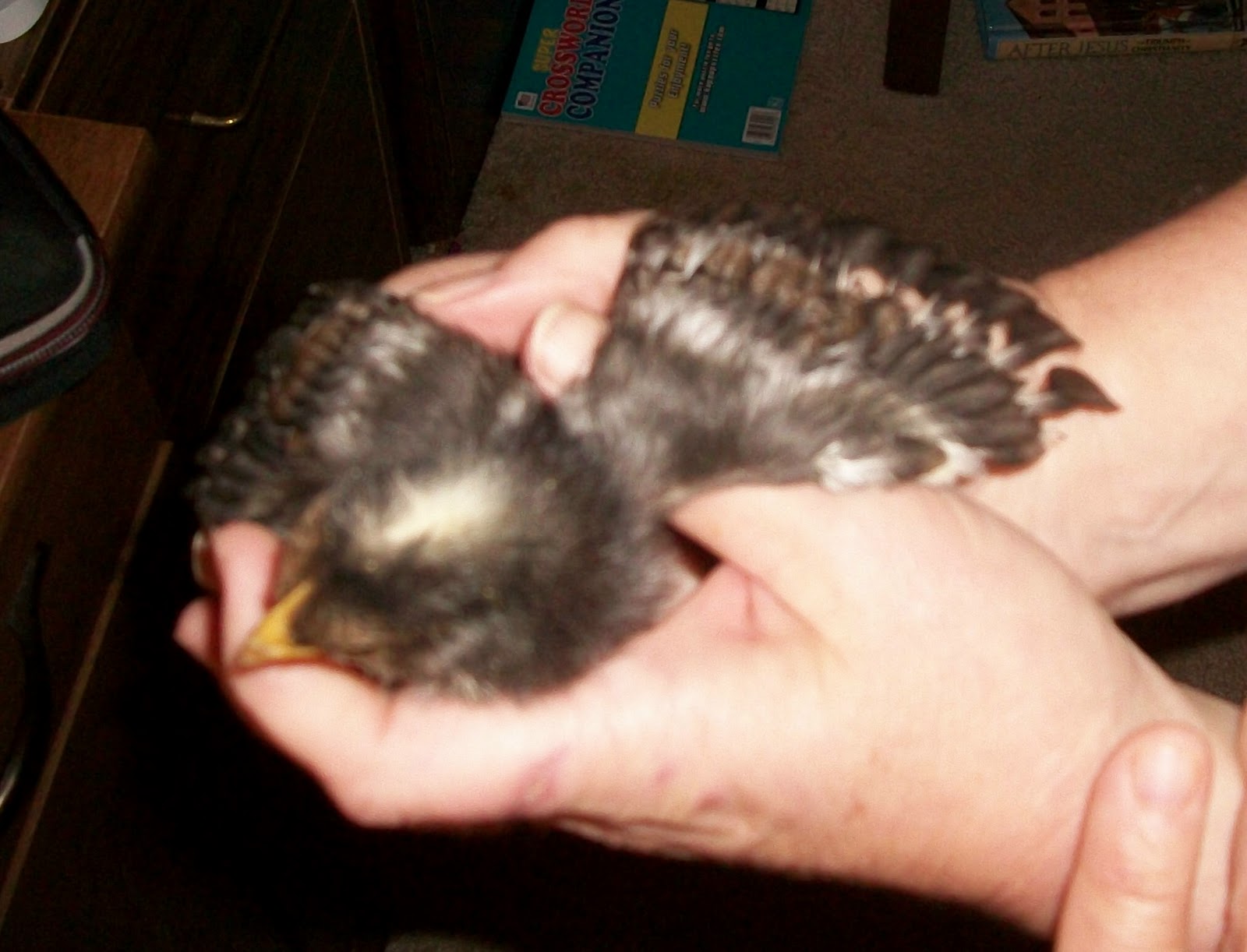
Since Pretty Face wouldn't adopt six of the seven newbies, we listen to a lot of cheep, cheep, cheep in the morning and in the evening, or when the weather isn't suitable for the chicks to be out on the front deck.  As I said before, we put the cage on a card table in the office/computer room, and when the chicks get loud, wanting attention, we take them out and hold them.

Fluffy, Sophia, Goldie, Cogburn
It's funny how these little birds have imprinted on us.  If we are elsewhere in the house and they hear us talking, they get REALLY loud with the chirping. As if to say, "Hey, we are in here. You've lost track of us!"   Which makes sense to a little chick mind.  When we watch Pretty Face being a broody hen this makes sense.  Her whole purpose for existence during this time is to be a mommy and constantly fret over her chicks.  This in turn allows them to run about the cage being happy-go-lucky, without a care in the world. The chicks seem relatively happy during time we can sit in the office doing stuff on the computers and they just do that happy, quiet little chirping noise.

Sophia checking out my desk
The times when they are most happy and content to the point of silence is when we hold them.

The two that we believe to be roosters are Cogburn and Blackburn.  Cogburn is demonstrating the most dominance by far.  Twyla named the one with the prettiest eyes Sophia.  She is just about as adventurous, if not more, than Cogburn.  When we are lying on the floor watching "24," she will often be the first one to decide to fly from Twyla to me, or vice-versa.  Yep, they've got enough flight feathers to do that now.  In fact, for a few of the oldest ones (two days makes a huge difference) flying three to five feet is not that difficult.  Cogburn, Sophia, and Blackburn will fly between Twyla and myself when we are sitting at our respective keyboards, which is no easy thing since we sit at right angles facing adjacent walls.  I don't just mean to the desks, either, I mean from arm to arm.

Cogburn and his flight feathers
If you are wondering why we are convinced so early on about which chicks are male, let me explain. When we got the second set of six chicks back in March, Twyla had done research on the web, and discovered that among the Black Sexlinks breed, a white crown on the top of the head usually signified a male.  Now, even though the feed store folk's supplier prides themselves on selling only hens for laying, someone is bound to make a mistake in sexing the chicks.  Although, I have to tell you, the people who do that stuff for a living fascinate me.  In case you didn't know, there is only about a 24 -36 hour window when it is easiest to detect the sex of a newly hatched chick.  The pro's who do it are usually latino immigrants who only get paid about $10 an hour.  You pick up a chick, turn it upside down and squeeze the cloaca so that it distends out, identify the male appendage or lack thereof, and toss the chick into the appropriate bin.  Examining each chick takes only 1 - 2 seconds max.

This is how we watch "24" on Netflix
Moxie loves her "chickie babies"
Even with chicks barely a week old, there are other signs that indicate sex, and of course, they are behavioral.  Cogburn immediately displayed such behavior.  Much more fearless than the others.  Wants to be up high as much as possible. Much noisier.  He doesn't make so much of the softer cheeping noises.  It's the same kind of behavior that we saw in Brewster, only more so.  Because these chicks came from other free-range chickens, they are not so pure-bred.  But we like that. Trying to maintain pure breed lines for maximum egg production is what leads to deteriorating genetic stock.  I'd rather have a little less egg production but have healthier chickens.  I look forward to the day when we no longer have to buy any more chickens from the supermarket.

Twyla recently posted on her blog about Moxie the Wonderdog.  If you haven't read it yet, be sure to do so. Perhaps Moxie's happiest time is when she is laying between us on the office floor while we watch Netflix and  have the chicks there.  She acts like any bitch that I've ever seen with puppies.  She just wants to nuzzle them and lick them.  The chicks show no fear at all.  When the sun is out and it's over 60° F outside, I put the chicks on the picnic table on the front deck. Moxie has to jump up there and act like the grand protector of the realm.  By the time these chickens are fully grown, they will be thinking of Moxie as just an odd four-legged sister.

I don't really have that much patience for staging photos.  I have always thought the best pictures happen naturally.  I didn't know, until we started raising chickens, that baby chicks love to hop up on their mother's back.  I've seen the three little ones outside do it with Pretty Face quite a bit.  Last night as I'm focusing on the finale to season eight of "24," Twyla softly says, "Do you still have the camera?"
Goldie on Moxie's head

And I look over to see that Goldie has decided to hop onto Moxie's head, and she stayed there long enough for me to get the picture.  Actually about six or seven pictures, but this is the best one.

I think when I get the third coup built outside, I'm going to miss them a little bit.  I know I won't miss the little chick turds and having to have plastic sheeting on the card table, and hearing them cheep loudly when I leave the room.  The great thing about farm life is that it's always changing and it's never boring.  Nothing worth having is ever really easy.

Shalom,   Moshe

Tuesday, October 19, 2010

Pretty Face Counts to Three

Who woulda thunk that a chicken could count.  At least to three.

You have to read the last post to understand the rest of this.  Last night, well after dark, we went out to slip the seven new chicks under Pretty Face.  It seemed like a successful insertion.

Pretty Face and her three chicks: Peep, Bo-Peep, and Blondie
If you've been keeping up with this blog, you know that I originally put three eggs under Pretty Face.  Two of them hatched.

We went down to the broody coop this morning at about 07:00, just as the sky was hinting of dawn over the southeastern  mountain ridge.  We opened the coop to find Pretty Face had huddled the two original chicks and the one blonde chick at her side and the rest of the chicks were huddled by themselves over in the corner.

I raced up to the house with the ceramic dishes in hand to quickly mix up some chick feed and get it back down to them.  When I got back and put the dish down in the coop, Pretty Face and "her" chicks began feeding, but if one of the other chicks tried to approach the dish, she would peck them hard and make a ferocious chicken noise that I can only describe as a low growl.

We knew right then that the other six chicks had been rejected.  She picked one, the "Blondie" who looks like a smaller clone of Bo-Peep.  But she only picked one.  As if to say, "I started with three eggs, and anything else just isn't working for me."

Twyla was wearing this big old winter coat and so we put three chicks in each waist pocket and walked back up to the house, brought the cage back into the warm bathroom and put them all back in.  But that wouldn't work for more than a few hours, so I cleared space on a table in the office/work room and set up the cage in there.

Moxie is really going crazy wishing she could mother them.  We've had them out, holding them and making them feel safe.  They really do act like they need some mothering.  A bottle of hot water in a towel, plenty of food and water is available, but if they hear our voices, they chirp like crazy and only settle down when we talk to them or hold them.

I really have to wonder if I'm ever going to get to eat my own home grown, free-range chicken for Channukah.