Please don't get me wrong. Don't lump me in with the crazies. I have absolutely no tolerance for the Earthfirst, or PETA people, unless PETA stands for People Eating Tasty Animals. I also think that the Enviro-Whackos who helped get DDT banned are responsible for mass murder in the millions. Sometimes chemicals are necessary. Indiscriminate use of chemicals is stupid and wrong. Wisdom involves knowing what, when, and how to use things properly.
I didn't spray insecticides last year and so far haven't needed to this year. Did I have problems? Of course. We also raise chickens. Some of my veggie seedlings weren't caged or protected well enough and they ate a couple of my cabbage plants, severely damaged one of my broccoli plants and totally destroyed my bed of mustard greens. The chickens aren't free-ranging right now. Not unless some huge windfall of money allows me to put adequate fencing around all my veggies. We don't have enough space to grow enough veggies for the chickens to eat what they want and leave us the rest.
 Not long ago, a single cut worm (that's all I could find) destroyed five out of six of my Swiss Chard plants, until I sifted through the soil and found him. Cut worms really make me angry because they don't eat the whole plant. They just cruise along in the half inch of soil, just below the surface and when they get to a juicy vegetable plant, they eat just the part that's convenient and the next day you come out to find the rest of the plant that was standing four to twelve inches in beauty now lying dead.
Now maybe some of you are thinking that it would have been smart to use plastic cups or half a tin can or toilet paper roll centers as ring barriers around each little plant. You'd be right, but I hate having to do any more work than necessary, and if I didn't have cutworms last year, I wasn't expecting them this year. I have only found two worms and there isn't any more evidence of them now. We only have a few plants that are in the ground in well amended soil. All the stuff in straw bales is not in danger of cutworms. Another big plus for using this technique.
The plants could still be in danger from all sorts of other pests, but I've learned a wonderful thing. Except for Biblical scale, wiping-everything-out plagues, most infestations are minor and can be dealt with without panicking. Most of my insect problems are being dealt with even while I am unaware of it, and it's mostly because I haven't used any chemical pesticides. It's very hard to engineer a chemical that kills only certain insects and leaves others alone, and the ones that make such a claim can end up having other effects years or months later that could be even worse. Maybe we are just overly blessed by God letting us live in this place; for God leading Twyla to buy this particular property. I just know that I don't want to mess it up.
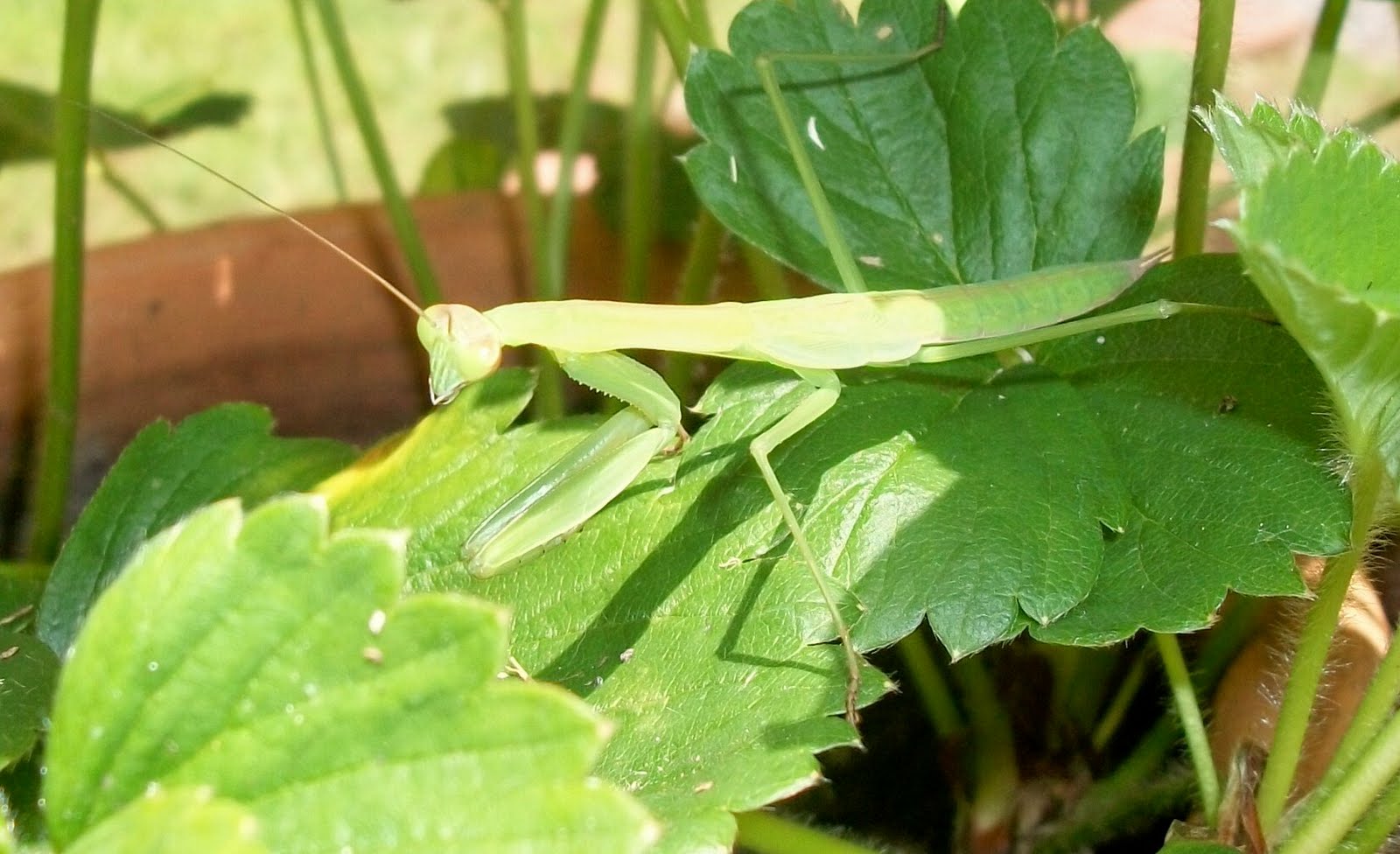 |
| A friend from last year on the strawberries |
Last year, I seemed to come across a praying mantis every time I turned around in the yard. Praying mantids are indiscriminate predators. By that, I mean that they will kill and eat any and all other insects, including their own species if they are hungry and the opportunity is there. If you read the stuff at the link I provided you might keep yourself from missing out on them.
 |
| Ladybug larvae |
Other insects, such as ladybugs, Coccinella septempunctata eat only the bad bugs, such as aphids. We must live in the Mecca of the ladybug world. When they first come out, you can see thousands of them in a square yard, but now I just see them here and there. Ladybugs have a penchant for crawling into warm homes in order to winter over and then come out in a vengeance when the weather starts to warm up a little bit. Some people are quite vexed by this development and will express their ire most loudly.
Ladybugs even eat the bad bugs when they are still in the larval stage, not looking anything like adult ladybugs.
I don't know much about them and haven't seen any yet, but green lacewing larvae are also supposed to be great predators of plant harming insects. The adult lacewing flies are harmless to plants, only eating pollen and nectar. Since they are so small they probably pollinate plants that bees are too big to get into.
 |
| Ground Beetle |
I actually saw a ground beetle today when I was planting some flox on the back slope. I'm glad that they are so pretty and easy to spot, since these guys actually kill the darned cutworms that I hate so much. The one I saw was more on the cobalt blue side. It was barely big enough to sit on a nickel.
I don't see the variety of birds up here that I used to see further south and to the west of Atlanta. The bird we see the most is the ruby throated hummingbird. In case you didn't know, hummingbirds get all their protein from eating small insects, such as mosquitoes and other pests. They don't just suck nectar from flowers or the sugar water from my feeders. The other great mosquito controllers around here are the dragonflies, which can eat up to fifty times their weight in mosquitoes a day and catch them on the fly, er, in the air. But that's why you primarily see dragonflies where there are bodies of standing water, since that's what's required for mosquitoes to breed.
There is also the actual benefit of having some insects breeding and creating larva on the farm. When I'm out digging up composted soil or trying to create a new bed for something. I will find grubs from time to time and they are probably of the Japanese beetle or June bug variety. To my chickens they are candy. Same thing goes for fly larva that I find in the compost sometimes. The chickens get to free-range during the winter months and scratch such treats out of the soil on their own. What a benefit for us.
 |
| Hey! How do I get in here? |
 |
| I don't think I can ride like this. |
 |
| Oh, come on! I wanna go! |
Pickles likes to play hard all day long, follow me around the garden and supervise, and then sleep around my head or on Twyla's hair all night. He is quite a lovable cat.
To see some other beneficial bugs, go to this site.


