"Good intentions will always be pleaded for every assumption of authority ... the Constitution was made to guard against the dangers of good intentions. There are men in all ages who mean to govern well, but they mean to govern. They promise to be good masters, but they mean to be masters." - Noah Webster


"There is no worse tyranny than forcing a man to pay for what he does not want just because you think it would be good for him."
-- Robert A. Heinlein

Showing posts with label free-range chickens. Show all posts

Monday, May 2, 2011

Pest Control

Maybe you can relate, or maybe you can't, but there is no joy like walking out to your garden, picking some big green leaves of Romaine or Butter crunch, or some of the lower leaves of the head lettuce and knowing that they only need a little bit of rinsing to get some soil off the bottom of the stems and then you can munch away on them.  No need to worry if I'm ingesting some sort of dangerous chemical into my body.  Such is the way of organic gardening.

Please don't get me wrong.  Don't lump me in with the crazies.  I have absolutely no tolerance for the Earthfirst, or PETA people, unless PETA stands for People Eating Tasty Animals.  I also think that the Enviro-Whackos who helped get DDT banned are responsible for mass murder in the millions.  Sometimes chemicals are necessary.  Indiscriminate use of chemicals is stupid and wrong.  Wisdom involves knowing what, when, and how to use things properly.

I didn't spray insecticides last year and so far haven't needed to this year.  Did I have problems?  Of course.  We also raise chickens.  Some of my veggie seedlings weren't caged or protected well enough and they ate a couple of my cabbage plants, severely damaged one of my broccoli plants and totally destroyed my bed of mustard greens.   The chickens aren't free-ranging right now.  Not unless some huge windfall of money allows me to put adequate fencing around all my veggies.  We don't have enough space to grow enough veggies for the chickens to eat what they want and leave us the rest.


 Not long ago, a single cut worm (that's all I could find) destroyed five out of six of my Swiss Chard plants, until I sifted through the soil and found him.  Cut worms really make me angry because they don't eat the whole plant.  They just cruise along in the half inch of soil, just below the surface and when they get to a juicy vegetable plant, they eat just the part that's convenient and the next day you come out to find the rest of the plant that was standing four to twelve inches in beauty now lying dead.

Now maybe some of you are thinking that it would have been smart to use plastic cups or half a tin can or toilet paper roll centers as ring barriers around each little plant.  You'd be right, but I hate having to do any more work than necessary, and if I didn't have cutworms last year, I wasn't expecting them this year.  I have only found two worms and there isn't any more evidence of them now.  We only have a few plants that are in the ground in well amended soil.  All the stuff in straw bales is not in danger of cutworms.  Another big plus for using this technique.

The plants could still be in danger from all sorts of other pests, but I've learned a wonderful thing.  Except for Biblical scale, wiping-everything-out plagues, most infestations are minor and can be dealt with without panicking.  Most of my insect problems are being dealt with even while I am unaware of it, and it's mostly because I haven't used any chemical pesticides.  It's very hard to engineer a chemical that kills only certain insects and leaves others alone, and the ones that make such a claim can end up having other effects years or months later that could be even worse.  Maybe we are just overly blessed by God letting us live in this place; for God leading Twyla to buy this particular property.  I just know that I don't want to mess it up.
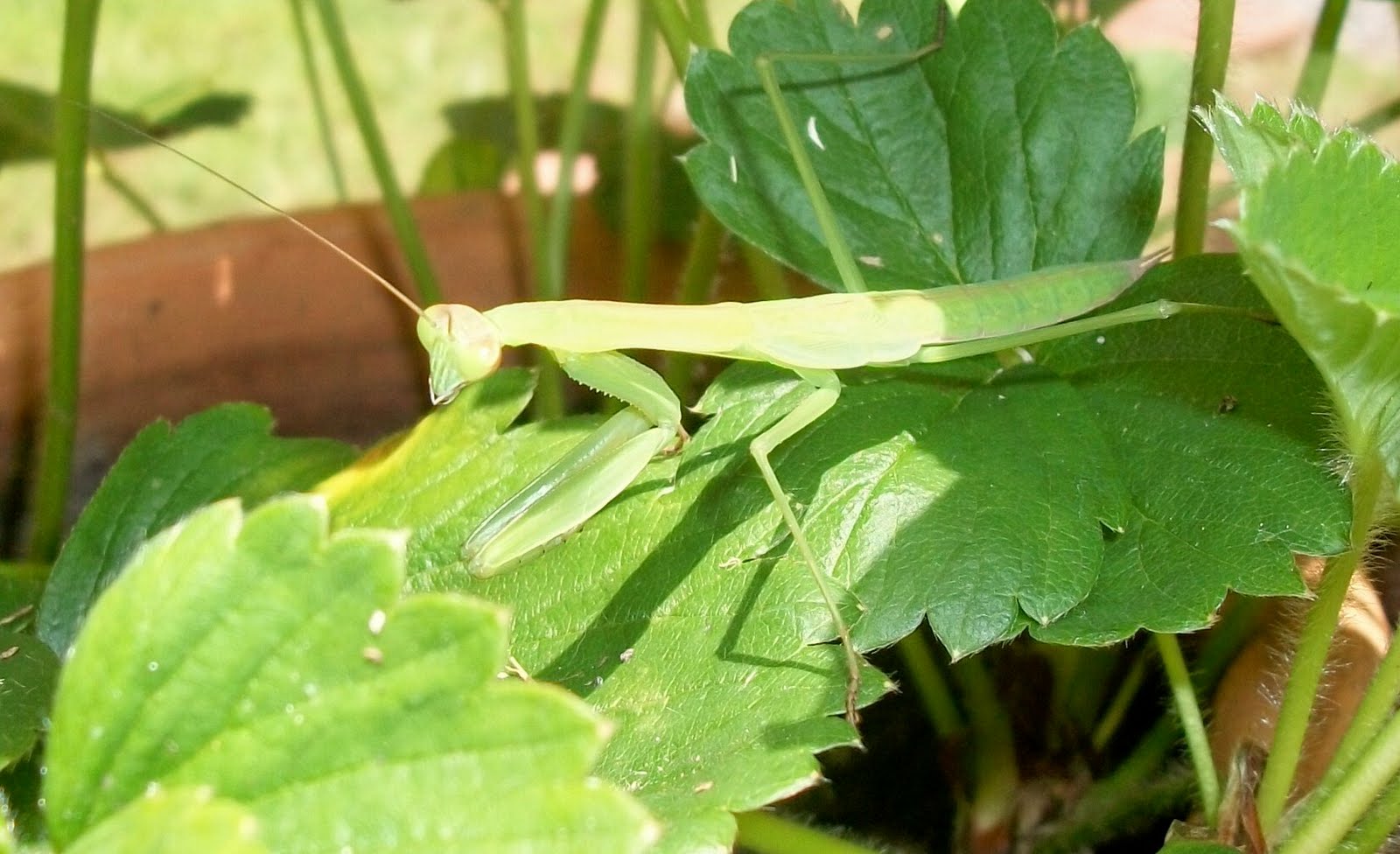
A friend from last year on the strawberries

Last year, I seemed to come across a praying mantis  every time I turned around in the yard.  Praying mantids are indiscriminate predators.  By that, I mean that they will kill and eat any and all other insects, including their own species if they are hungry and the opportunity is there.  If you read the stuff at the link I provided you might keep yourself from missing out on them.

Ladybug larvae

Other insects, such as ladybugsCoccinella septempunctata eat only the bad bugs, such as aphids.  We must live in the Mecca of the ladybug world.  When they first come out, you can see thousands of them in a square yard, but now I just see them here and there.  Ladybugs have a penchant for crawling into warm homes in order to winter over and then come out in a vengeance when the weather starts to warm up a little bit.  Some people are quite vexed by this development and will express their ire most loudly.

 Ladybugs even eat the bad bugs when they are still in the larval stage, not looking anything like adult ladybugs.

I don't know much about them and haven't seen any yet, but green lacewing larvae are also supposed to be great predators of plant harming insects. The adult lacewing flies are harmless to plants, only eating pollen and nectar.  Since they are so small they probably pollinate plants that bees are too big to get into.


Ground Beetle

I actually saw a ground beetle today when I was planting some flox on the back slope.  I'm glad that they are so pretty and easy to spot, since these guys actually kill the darned cutworms that I hate so much.  The one I saw was more on the cobalt blue side.  It was barely big enough to sit on a nickel.

I don't see the variety of birds up here that I used to see further south and to the west of Atlanta.  The bird we see the most is the ruby throated hummingbird.  In case you didn't know, hummingbirds get all their protein from eating small insects, such as mosquitoes and other pests.  They don't just suck nectar from flowers or the sugar water from my feeders.  The other great mosquito controllers around here are the dragonflies, which can eat up to fifty times their weight in mosquitoes a day and catch them on the fly, er, in the air.  But that's why you primarily see dragonflies where there are bodies of standing water, since that's what's required for mosquitoes to breed.

There is also the actual benefit of having some insects breeding and creating larva on the farm.  When I'm out digging up composted soil or trying to create a new bed for something. I will find grubs from time to time and they are probably of the Japanese beetle or June bug variety.  To my chickens they are candy.  Same thing goes for fly larva that I find in the compost sometimes.  The chickens get to free-range during the winter months and scratch such treats out of the soil on their own.  What a benefit for us.

Hey!  How do I get in here?
Some people may think I'm crazy for not taking a preventative stance by spraying or dusting, but I figure if I'm willing to lose just a little of my produce to keep the predators around and healthy, we will be rewarded for it down the road when there won't be any commercial chemical poisons around to do my killin' for me.  I try to look over everything growing on the farm every day and keep my eye out for any signs that there is a problem.  And because we believe in prayer, obedience to Torah, and the mercies of Adonai, we'll stick with this method until or unless we get hit with some kind of massive infestation.  And then I only have the natural pyrethrin stuff to mix up, in order to keep the damage minimal.  It is there only as a last resort.  I much prefer to be able to reach down and pick a leaf of lettuce or a pea pod, or a really nice, ripe strawberry and just pop it in my mouth.


I don't think I can ride like this.
 Twyla thinks that the reason I haven't seen any praying mantids this year is because of Pickles.  Pickles has killed numerous tiger swallowtail butterflies and just loves to hunt. He's still a kitten and I don't think he'd pay any attention to me if I scolded him for pouncing on a mantis.  Sometimes you just have to accept things the way they are.  I have to look on the bright side.  I seriously doubt that we will ever have a problem with mice or moles.  There are always trade-offs.  I could worry about how much it costs to feed the dogs, but that night a couple of weeks ago when Moxie and Beau chased a full grown bear out of the yard reminded me that they are worth more than just the companionship.


Oh, come on!  I wanna go!


Pickles likes to play hard all day long, follow me around the garden and supervise, and then sleep around my head or on Twyla's hair all night.  He is quite a lovable cat.


To see some other beneficial bugs, go to this site.

Wednesday, March 23, 2011

Spring Planting

Feeling good.  Feeling fine.  Spring is here and I get to get some sun.  I spent most of the day yesterday in shorts and no shirt, running around the yard doing various things.  We had 100 straw bales delivered two weeks ago and they are ready for planting.  We have our tomato starts and some more Swiss chard and other cruciferous types.  I've got some more strawberries; six more plants.  Most of the ones we had from last year wintered over nicely

Straw bales arranged for planting


I even got a couple of grape vines from the feed store and I'm going to plant them along the driveway.  I will need to put up a fence rail there for them. I got the only two vines left at the store.  One is Concord and the other is Fredonia.  Fredonia. Reminds me of the Marx brothers movie, "Duck Soup," and the mythical country of  Freedonia.

This time we doubled the straw bales side by side to achieve more stability.  Only one little row at the back is still single.  I also kept a couple of bales for the backyard for more herbs.  Then two more bales went under the porch for alternate bedding for the chickens.  Speaking of chickens, there are dandelions and other wild edible greens that are busting out all over and the chickens are loving it.  I will snatch up handfuls of dandelion and feed them through the wire.  I wish I could still let them free to eat what they wanted to, but I have to protect my plants, so we are back to bringing the food to them.  As I was digging out my corn and bean area I must have gathered a dozen or more grubs which I fed to the chickens and, of course, that is like candy to a little kid.
Leafy walkways that will smother the weeds

This season I am doing much better with the walk areas by piling on the leaves in a very thick fashion.  They will smother the grass and other weeds and as they decompose they will help hold in even more moisture between the bales and further condition the soil for next year.  The other advantage in doubling the bales is that we can do more of the companion gardening.  Twyla has been reading up on it and we will be planting marigolds with the tomatoes. I'll post more about that after we get more things planted.

I also plan to get some good things done along the steep slope in the back yard to have more things planted in the next few days.  I still have a couple of berry plants that were given to us by an English woman in North Carolina.  I planted a McIntosh and a Gala apple tree in the two front corners of the property and it is so nice to see the little green buds starting to sprout.

Even though it means lots of hard work for the coming days, I'm really excited about getting it done and seeing all of these things growing.  We went out to dinner with some local folks who are also big into gardening and we were talking about how there just is no comparison between the stuff you pick fresh out of your own garden versus the stuff from the supermarket. You have no idea how many days or even weeks that produce has been in transit or sitting in a warehouse or distribution center somewhere.  I wish I had a dollar for every time I've shared one of my own homegrown tomatoes with someone who claimed to not like tomatoes, only to hear them say with surprise, "You mean THAT's what a tomato is supposed to taste like?!  Wow!"  And the same is true for lettuce, spinach, cabbage, peas, beans, and corn.

Tuesday, August 10, 2010

Chicken Arks

A beloved reader of this blog wanted more info on the chicken arks.  I also know of a dear lady friend who wants chickens, but her hubby is against the idea, ostensibly due to predators.  So herein, I will give some more detail about the arks and why they are working so well for us.  I will also give some basic instruction on the construction of said these movable coops.

Being very limited on capital resources, the goal was to make these arks in the cheapest possible manner while still meeting the requirements of A) not losing any chickens the the various predators, B) providing the highest nutritional standards of fresh vegetation and "other" natural foods besides the cracked corn and laying pellets, C) being able to move the chickens around the yard which both provides the fresh greenery and fertilizes future planting ground.

Most of the wood that went into the construction of these arks was salvage wood that I merely asked for and received from somebody down the road who had it laying out near a barn.  There are lots of such places in the area, and we have many more ideas for the use of such wood, but that's a subject for another post.  The point is: you can get a lot of stuff for free if you are just willing to ask.  The lumber was old pressure treated decking, well-weathered.  This is important, because you would never want to use fresh PT wood as something that the critters would be in constant contact with, due to the chemicals involved.  I think it is safe to say that this wood has since had most of the bad stuff leached out of it.  Of course, it is only the wood that is used for framing of the arks.  We had to buy some 1/4 inch oriented strand board (OSB) for the bottom and sides.  A  4' x 8' sheet costs about $8 (your price may vary).  I got the basic plan by googling "raising chickens" and came across http://www.raising-chickens.org/chicken-tractor.html which has a series of somewhat detailed photos to show you the basic design.  The size of their ark was too small for my tastes.  I wanted a design that would hold six chickens comfortably and provide at least a day's worth of grazing space.

I started with the idea that I wanted the base to be 4 feet by 8 feet for each ark holding six chickens a piece. That provides 5.33 square feet per chicken.  Now, if you are thinking  that seems like a tiny amount of space per chicken, just keep in mind that the chickens that lay your store bought eggs just sit in a cubical just big enough to lay their eggs and are just fed and watered by some machinery.  Our chickens get fresh air, sunshine, stray bugs, our personal attention and petting.  We pay attention to how much fresh vegetation they get.  And my next post will probably gross most of you out when it comes to feeding chickens.

We bought a hundred foot roll of the 48" rectangular wire fencing material.  I still have enough left to do a couple of more arks or to create cages of some other sort. The reason for using this instead of chicken wire is because it seems more open, but it is much stronger against predators than chicken wire. We have too many cats around here right now for snakes to be an issue.

There is enough space in the "loft" for a dozen chickens to roost, but there are only six, so they have plenty of room.  There is an opening in the middle of the floor with a ramp attached with hinges underneath. There is a rope and a pulley that I use to draw the ramp up to the floor when I need to move the ark. I attached a standard rope cleat on the end to secure the rope.  The pulley is hard to see in the photo.Ark One is about 40 percent heavier than Ark II because I was experimenting with design and what I learned from the first model, I applied to the second. To move the arks I made a single axle to place under one end of an ark when I want to move it.  It's very simple. Just a 2 x 4 with a couple of utility wheels fastened on with "shoulder" type lag screws; 3/8" diameter by 3" long, with flat washers. You should know that Twyla doesn't have the strength to move either of these arks.  I think most healthy men and some women could, but you need enough strength to pick up one end and use your foot to position the axle and then pick up and move the ark with the fixed handles at the other end.  If you are going to build one of these contraptions, you need to size it accordingly.

Once again, if you have any questions or comments, please leave them below.  Thanks for stopping by the farm.