"Good intentions will always be pleaded for every assumption of authority ... the Constitution was made to guard against the dangers of good intentions. There are men in all ages who mean to govern well, but they mean to govern. They promise to be good masters, but they mean to be masters." - Noah Webster


"There is no worse tyranny than forcing a man to pay for what he does not want just because you think it would be good for him."
-- Robert A. Heinlein

Showing posts with label bread. Show all posts

Tuesday, November 16, 2010

Joy of Baking

Hey, it's another rainy day, so you get the benefit of a second post for today.  Be sure to scroll down to the next post or click here to read that one first.

I had intended to write about the difference in bread making when it comes to freshly ground grain.  Today is a good day to do that. Yesterday, being so rainy, and seeing how I had given my remaining loaf of fresh wheat bread to our guests to take home,  I had ground and made enough dough for a fresh loaf of wheat/rye.  I don't have a precise ratio on the flour.  It's about one cup of rye flour, three cups of red wheat, and a half cup of store bought bread flour to adjust the moisture as needed.  I cook the way Justin Wilson did.  I can measure tablespoons and teaspoons in the palm of my hand.

Whole wheat/rye starting final rise before baking
When I had cable TV, I was a faithful fan of Alton Brown's "Good Eats" on the Food Network. His information was about the science of why food behaved the way it did, even down to the molecular level, so an aspiring chef could understand why recipes work, or don't work, and what to do about it.  One of his episodes was about making your own quality pizza at home.  It's really all about the crust.  It's all about the dough.  When you think about it, he's absolutely right. Assuming that you don't use ketchup for sauce, or leftover hamburger from a McDonald's bag, or some such nonsense, it really is the crust that makes or breaks a pizza.


What in the world did my talking about pizza have to do with making a loaf of wheat bread?  Hang in there. I really do have a point for those of you who like to make your own bread at home.

Dough ball ready for refrigeration
The first thing I learned from Alton is that when it comes to yeast breads, kneading is important.  Whether you use a Kitchenaid mixer or a bread machine or you like to make it a part of your upper body workout, kneading is crucial to the quality of your bread.  This is because of gluten development.  Gluten is a protein that gives bread that elastic, spongy, chewy quality that is so pleasing to the mouth. Some grains have more of these types of protein than others.  The less gluten in a flour, the more you may need to knead it.  When I say "development" I mean stretching out those protein chains instead of leaving them as knotted up balls inside the flour.  It's the combination of water and the kneading that accomplishes this.  Then the gluten gives that elastic quality that creates the tiny balloons which hold the CO2 that is produced by the yeast eating the sugar, and you get a nice fluffy loaf of bread.

The other tip that Alton gave was to refrigerate your dough ball for a few hours at minimum, or overnight at best, right after getting all the wet and dry ingredients kneaded thoroughly.  He didn't really explain this tip, probably due to lack of time, but I understood it intuitively.

When you buy flour from the store, it might have been ground months ago.  You can knead such dough thoroughly and only let it rest for an hour or so before punching down and re-forming your loaf before the final rise before baking.  This will produce a pretty decent loaf.  But when I started making bread from freshly ground flour, I noticed that no matter how much yeast I used, when I tried to do a standard rest and rise period, I ended up with a dense and somewhat crumbly loaf.  Then it came to me.
Our own precious sun-dried tomatoes


I'm grinding my own grain now.  This flour is the freshest you can get, and the proteins are still pretty much alive, albeit dormant.  The secret to denaturing the proteins was going to be in letting the dough rest overnight in the fridge, for at least 12 or more hours.  Let the water and the eating of the yeast on the sugars relax the proteins and prepare it for the final kneading.  Eureka!  The next loaf came out great, without a lot of extra kneading.  I didn't need to work harder, I just needed more patience.

I had made a loaf of focaccia bread a couple of weeks ago, and it was really just a test run.  It came out great. I had cooked it on my pizza stone.  Think of it as a pizza crust, but without any real topping, except for some sprinkled fresh herbs and maybe some sun dried tomato.  I put one thin layer on top of another with the olive oil and herb mix between and on top of the layers.
Sage, Oregano and Parsley from the back yard


Today I ground fresh grain to make the next batch of focaccia. This time I will take photos to share and will update them to this post accordingly.  I decided to experiment with the flour as well.  The ratio is one cup of rye, two and a half cups of red wheat, and a half cup of quinoa.  I think the quinoa has an aroma similar to semolina and I think it will add a nice touch of flavor to the bread.  I went out and snipped some fresh sage, oregano and parsley from the garden.  I'll mince up some fresh garlic. About two-thirds of that will go into the marinara sauce that Twyla wants to make, and the rest will go into some extra virgin olive oil to get layered into the bread before rising to bake.

First two layers with herb mix
UPDATE:  It's delicious.  Thursday, 18 NOV 10, 05:18  We will probably finish it off over the next three days.  Here are the additional pics.  But, darn it all, I forgot to carmelize a bunch of onion to go on it.  Oh well, maybe next time.

Ready for the oven
I split the one big dough ball into three roughly equal balls, about the size of softballs. I don't knead them anymore at this point, and if there are any large air bubbles in the dough it would just give it more character.  I roll out the dough with a rolling pin, just like making a pizza crust, and center it on the pizza stone.


---  I'm telling you, if you like home-made pizza, you GOTTA have a pizza stone.  Mine is so well used and well seasoned that it is as non-stick as teflon.  ---

Then I spread the garlic/herb/olive oil on, then repeat the step with the second dough ball, but then I add the moistened sun-dried tomatoes.  Then I repeat the step again with the third ball of dough and add more tomatoes. And the product that is ready for the oven looks like this:
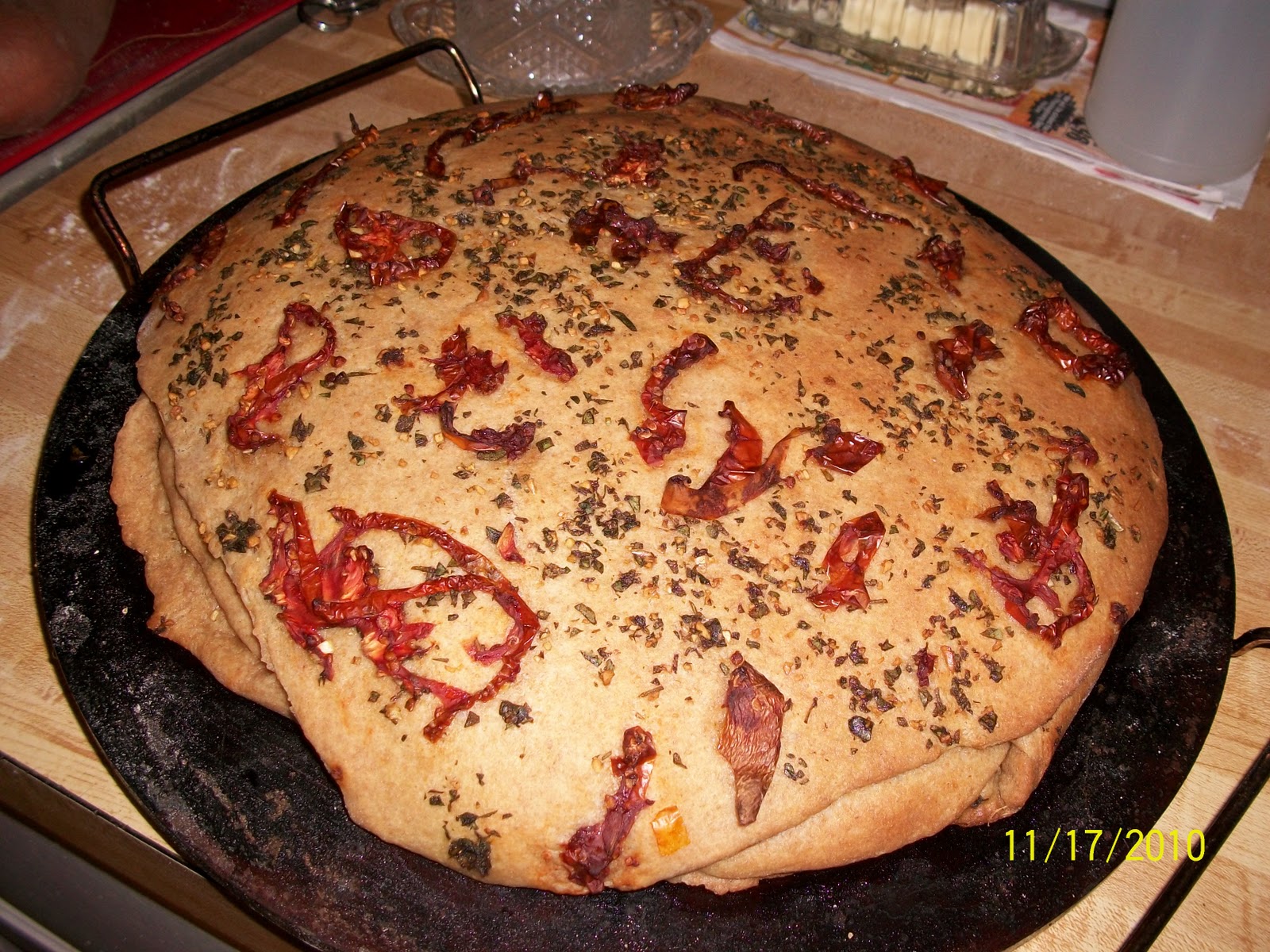

Yummy focaccia goodness
With the heat off, I leave it in the oven to rise again to just more than double in height, which takes about 45 minutes.  No need to take it out and pre-heat the oven.  I just check to make sure that it has risen according to plan and then fire the oven up to 350° F and set the timer for 35 minutes.

Notice the size difference on the stone?  The space change between the pieces of tomato?  This is a light and fluffy, melt-in-your-mouth masterpiece.


But it's a team effort.  I have to spend a lot of time outside taking care of other chores. Twyla was inside making the wonderful marinara/spaghetti sauce for dipping with this.  That just happened to be what we wanted with it this time. Seeing how we are both amateur chefs we sat at the table enjoying this, but then discussing how many other things would go well with it.  I could make a great Alfredo sauce from scratch.  It would be great just with olive oil and fresh ground pepper and some more herbs.  Because the layers don't really stick together because of the oil/herb mix, you could cut the center into squares and make awesome sandwiches out of it.

If there was a way that I could contain the smell of this bread baking and post it on this blog, it would make your mouth water.

Wednesday, August 11, 2010

What a Grind

This is our new grain mill. It's brand-spankin' new. But it's very old fashioned. The motor is my arm. To be completely honest, it's really my whole upper body. Believe me, when you've finished grinding enough grain for  a loaf of bread, you've had a little workout. But this is really a good thing. I can feel it in my biceps, triceps, pectorals, deltoids and the rest.

The real reward is the most delicious bread you could possibly have, and more importantly, it's far more nutritious than anything you could buy in the store, and that includes your local "fresh" bakery.  How can I say that? Because with rare exception, I'm betting even your local bakery buys its flour already ground in very large commercial bags of 50 - 100 pounds each. Flour that has been processed so that it can maintain a very long shelf life, having many of the best nutrients purposely removed.  In fact, you might not know that it is required that key ingredients be removed during the processing to render the flour "safe" meaning that it can't explode if rapidly dispersed.  But even back in the days before such factory processing was done, the mere act of grinding grain exposed it to rapid oxidation. Such oxidation means that the flour loses up to 90% of its best nutrition within a week of being ground.

Hard Red Wheat
I will warn you that you might run into websites that challenge that assertion. They don't back it up with any facts, mind you, but you should already know that you can't believe everything you see on the internet. Think about it.  If you break the skin on a piece of fruit, what begins to happen to that fruit? Did you know that whole grain kernels have been found in storage that are hundreds of years old that are still capable of sprouting.  Why is that?  The big food companies that produce flour have to add vitamins and other things to the flour to keep it from rapidly spoiling. Any microbiologist can tell you that enzymes and amino acids and other organic compounds rapidly deteriorate once they are exposed to air.  You can do your own research, and you can believe what you want to, but my scientific mind and common sense tell me that this is the most nutritional way to go.

Organic Quinoa
We will be adding several more varieties of grains and even legumes to our inventory, but the two that we started with are the hard red wheat, and organic quinoa (pronounced "keen-wah").  Because Twyla has a thyroid condition and fibromyalgia, she is sensitive to gluten, but my suspicion is that she is mostly sensitive to the additives in most processed, factory produced foods. The quinoa is something that she can eat instead of pasta.  Since I already had a manual pasta maker, that's going to be one of the things I look forward to making. It will be very economical compared to buying already made quinoa pasta (about $6 for a one pound box). The red wheat is much cheaper; it works out to about $1.50 per pound. Of course it's not tremendously cheaper than store bought bread, but it is cheaper. But more importantly, it is nutrient dense food that will keep that way right up until we grind it and turn it into bread.  One very cool thing about grinding the grain is that the volume of the grain about doubles when it is ground, so a cup of red wheat and a half cup of quinoa becomes about 3 cups of flour.

Why a MANUAL grain mill?
Maybe you've heard of "cap & trade"?  A proposed bill that the leftists in government would like to impose on the United States. Along with other nefarious and unconstitutional acts, this would pretty much destroy energy production in this country, and you could expect for us to become a third-world banana republic in short order.  Of course, something else could happen.  Some natural disaster, or terrorist attack.  Did you know that all some rogue enemy has to do is to explode a nuclear weapon somewhere in high altitude over North America and it would destroy all the electronics for hundreds of miles from the electro-magnetic pulse or EMP.  It could take weeks or months to restore power, if ever. The neat thing about this model of grain mill is that the pulley that comes with it is a v-belt machine pulley, which means that I could mount a small motor on the board next to it and just get an old standard automotive v-belt and I could grind 10 pounds in ten minutes. Or, I could take an old stationary exercise bike and run a belt from the wheel of that thing to the pulley.There are many ways I could make it work easier.  But had we bought an electric model?  In a power shortage or outage, it would just become an interesting door stop.

In some future posts, I'll be sharing about the restoration and installation of an old porcelain and steel wood cook stove that dates from about 1913. That's going to become our primary source of heat during the winter in our little corner of the mountain.

I don't know if I've shared enough information to satisfy you. If you'd like to know more, please leave a comment below.  For now, I'll leave you with my basic bread recipe:

About three cups of flour (the blend I talk about above)
One egg (yep, from our own chickens)
One cup of milk (evaporated, or reconstituted from dry, or whatever)
Two teaspoons of yeast
Half cup of water
Three tablespoons olive oil (or vegetable oil)
Two tablespoons of sugar
A scant pinch of cinnamon, ginger, or nutmeg, or all three (they are not for flavor, they actually enhance the yeast growth, but the flavor is an added benefit)
One teaspoon of salt

Dissolve the sugar in the warm half cup of water and add the spices. The water should be warm and not hot, or not above 95 F. Then add the yeast and let it dissolve and give it about 15 minutes to bloom and start eating the sugar. Then whip in the egg and milk and oil until blended thoroughly, then start blending in the flour and salt.  I have no set measurements for any of this. You may need to add a little more flour or water depending on the texture and handling of the bread.  I adjust the mixture until the dough ball can be kneaded without sticking to my skin. No moister and no drier than that.  Then it goes back in the bowl and covered with plastic wrap or into a ziploc bag and then into the refrigerator. If that seems odd, don't let it put you off.  Allowing the dough to rest and rise very, very slowly makes for a much smoother, even texture in the final product. Your patience will be rewarded.

B'rakhot Adonai,

Moshe